How to make AI meeting notes auditable
AI notetakers solved transcription and broke something subtler: organisations now have thousands of fluent, plausible summaries that no accountable human ever verified. That’s a liability dressed as productivity.
The problem with “the AI wrote it down”
- Summaries aren’t records. A summary is a model’s best guess at what mattered. Nobody signed it; nobody is accountable for it.
- Attribution drifts. Models misattribute who said what, and who decided, with complete confidence. Repeated downstream, the error becomes the record.
- Everything is editable. AI notes land in docs anyone can change after the fact, which defeats them as evidence.
- Discovery cuts both ways. Unreviewed AI summaries are discoverable in disputes, including the wrong ones.
Five principles for auditable AI capture
- Human review before record. AI may draft; only a person promotes a draft to a record. The reviewer’s name goes on it.
- Provenance attached. Every extracted claim should point back to its source (the transcript, thread, or document it came from), so review is verification, not faith.
- Confidence made visible. An extraction that is 60% sure should look different from one that is 95% sure. Hiding uncertainty turns guesses into facts.
- Immutable once filed. After sign-off, changes append. They don’t overwrite. Tamper-evident history is what makes a record evidence.
- Scoped access, defined retention. Who can see it, who can act on it, how long it lives. All decided by policy, not by whichever drive the file landed in.
A quick test for your current setup
| Question | Pass looks like |
|---|---|
| Who approved this summary as accurate? | A named person, on the record |
| Can you show what the AI got from where? | Source linked per claim |
| Has it changed since it was filed? | Provably not, or an append-only history of how |
| Who could see and edit it? | A role list, not “anyone with the link” |
From a transcript to an approved decision record
Fictional example
A meeting transcript says: “We recommend renewing the provider for one year. Switching now could put the delivery date at risk. We considered migrating this quarter, but rejected that timing. The budget owner still needs to approve the renewal.”
The draft should preserve the recommendation, reason and rejected alternative. Its status is proposed, because the transcript explicitly says approval is outstanding.
Use these five steps:
Keep the source and its context
Retain a reference to the transcript or document, its date and the relevant passage. Use material you are authorized to process, and preserve any uncertainty or disagreement.
Draft the decision without inventing approval
Capture the proposed choice, rationale, alternatives considered and people involved. Separate what the source states from missing information. In this example, record the renewal as proposed and identify the outstanding budget-owner approval.
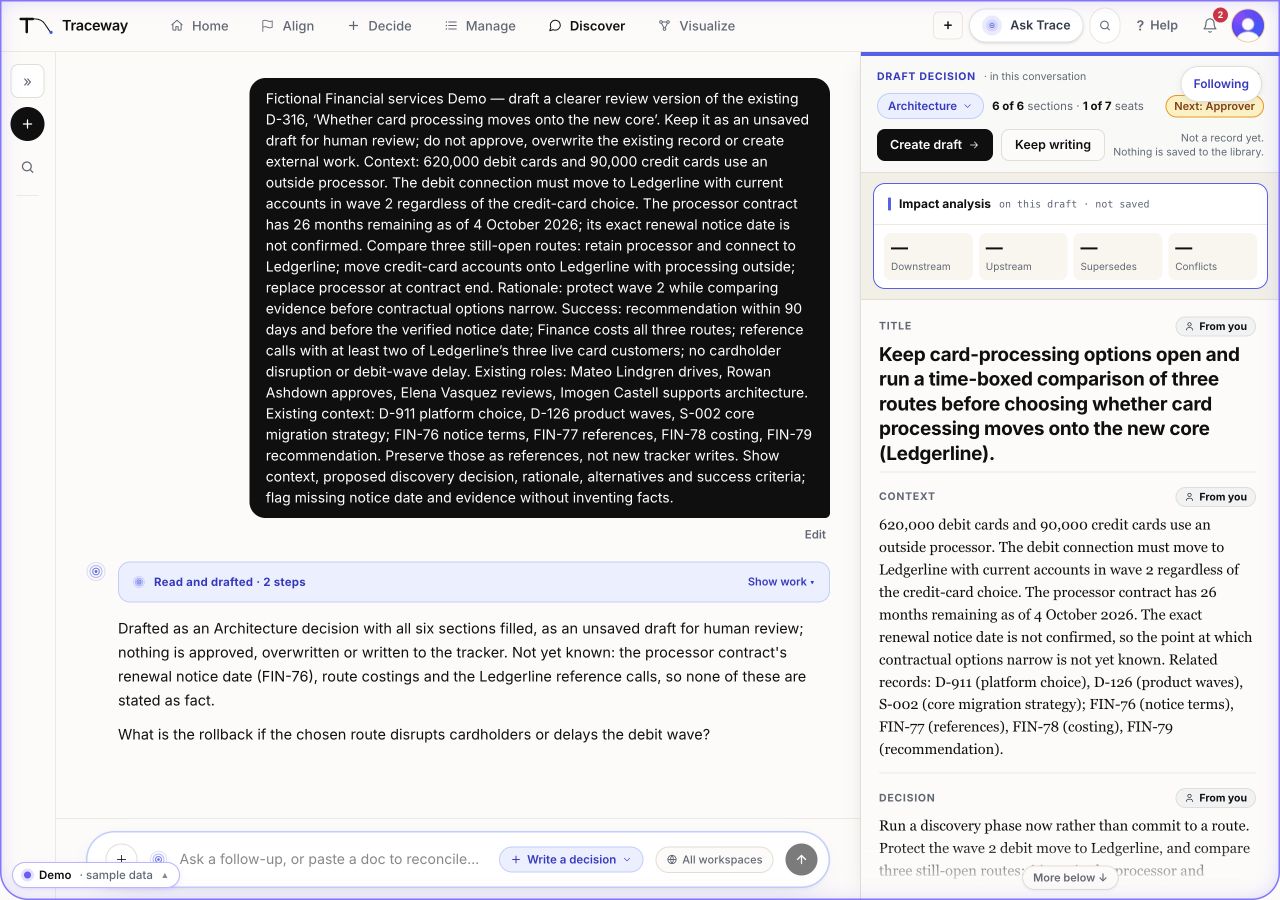
Fictional Demo data. The original Discover proposal conversation reopened after the draft was saved. The full composer is visible; this is not a fresh pre-save capture. View full-size screenshot. Have a person verify the draft
Compare the draft with the source. Correct attribution, check why alternatives were rejected and resolve missing information with the participants. Reviewing the draft for accuracy does not itself authorize the decision.
Record the authorized decision
Route the verified proposal through your organization’s approval process. Record the outcome, who acted and when. Keep a request for changes or a rejection distinct from approval.
Keep the history available for review
Retain the approved record, its source references and approval evidence. Record later changes without obscuring what was previously approved. Test whether a reviewer can retrieve the history and obtain the evidence they need.
How Traceway implements this
Traceway treats AI as a drafting assistant, never an author of record: Trace extracts decisions from the conversation with a confidence read on every field and the source alongside; a human approves every word before anything is filed; approval routes to the accountable person; and the filed record lives on an insert-only, tamper-evident trail with role-based access. The AI does the busywork. People keep the judgement and the accountability.
When AI agents build from the decisions you record, see spec-driven development, and why agents still drift.
Traceway is a platform for recording and approving business decisions. When a decision changes, its owners can see which commitments to revisit.
Stop losing the why.
Traceway is the system of record for decisions: AI capture, real governance, an audit-grade trail, and a chain from strategy to the work.
Book a demo