A decision record template that holds up
Most decision documents record the outcome and lose the reasoning. This template captures both, in a form that still makes sense a year later, to someone who wasn’t there.
Download the decision register (Excel) with blank decision and work-review tables, plus a fictional example showing how a proposed replacement refers to the approved decision.
Use the changed-decision worked example to follow the commitments needing review, and the approval-history example to check the evidence associated with each version.
The template
Field-by-field guidance
The decision
Write the call as an instruction to the future, not minutes of the past. “Consolidate on one cloud; exit the second provider at renewal” can be executed. “We discussed cloud strategy” cannot.
Why now
Decisions are forced by moments: a renewal, an incident, a hire. Record the moment. Without it, every future reader judges the decision against today’s conditions and concludes you were wrong.
Alternatives considered
The most valuable section and the least written. Rejected options (and the reasons) are what stop the organisation from rediscovering them annually. Always include “do nothing” when it was a live option.
Roles
Name the person or group with authority to approve the decision. If several people must sign off, record whose approval is required, whether approvals happen in order, and who resolves a disagreement. Use the roles from your decision framework to make that clear.
Review by
Some decisions are permanent; many are “until conditions change.” Naming the trigger (“revisit at contract renewal”) turns a future argument into a calendar entry.
Make the template enforce itself
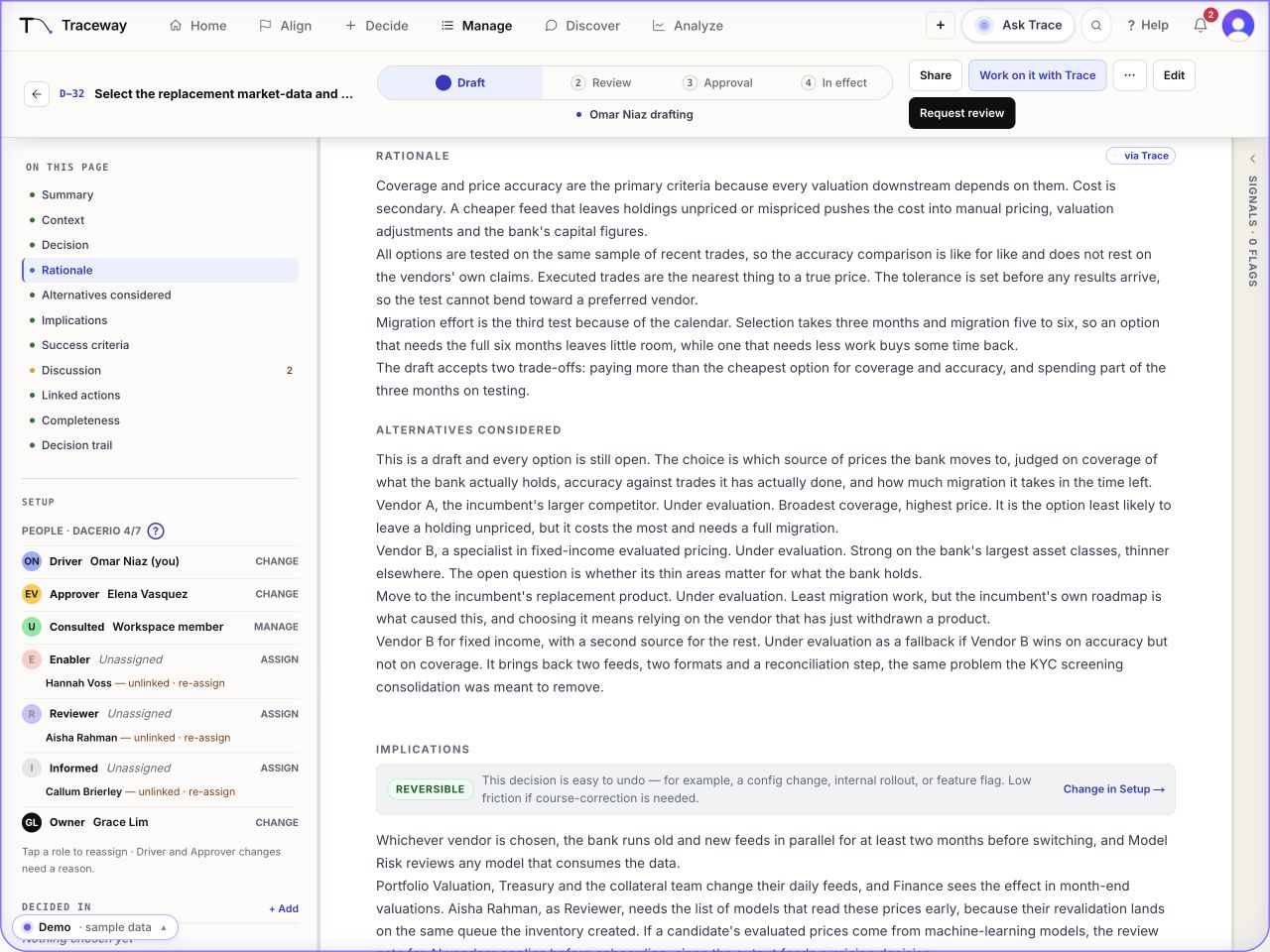
A template is only as good as its weakest entry. In Traceway, this structure isn’t a document people fill in. Capture drafts it from the conversation you already had, DACERIO routing won’t mark it approved until the accountable person signs, and the record lands on a tamper-evident trail, linked to the goal it serves.
If AI coding agents build from your decision records, see spec-driven development, and why agents still drift.
Traceway is a platform for recording and approving business decisions. When a decision changes, its owners can see which commitments to revisit.
Stop losing the why.
Traceway is the system of record for decisions: AI capture, real governance, an audit-grade trail, and a chain from strategy to the work.
Book a demo