If you run engineering, you get asked the same three questions long after the work shipped. Why did we choose this? Who agreed to move the date? Is that exception still allowed? The answers usually exist. They are in a pull request, a planning thread, a slide from a steering meeting and the memory of someone who has since changed teams.
I founded Traceway, and this page is written for a VP of Engineering or CTO deciding whether a decision record is worth another tool. It describes what Traceway does today, and where it stops.
The decisions that outlive the sprint
Most engineering choices are well served by the tools you already have. A ticket records the task and a pull request records the change. Three kinds of decision tend to fall between them.
- Architecture exceptions. A team is allowed to break a standard for a reason and for a time. The reason and the expiry date are what matter a year later. Our worked example, when an architecture exception reaches its expiry date, follows one through a review.
- Platform and supplier choices. The technical reasoning sits in an ADR. The spend, the contract term and the accepted risk belong to people who do not review code. See when an ADR needs business approval.
- Scope and date trade-offs. Someone chose to ship without a feature, or to slip a quarter to finish a migration. The roadmap shows the new date. It rarely shows who chose it and what they gave up.
What Traceway records
A decision record in Traceway holds the call, the reason for making it now, the alternatives that were set aside, the people in each role and their approval. Trace AI can draft and refine the record from a conversation, and people can write it directly. Approval stays a separate human act.
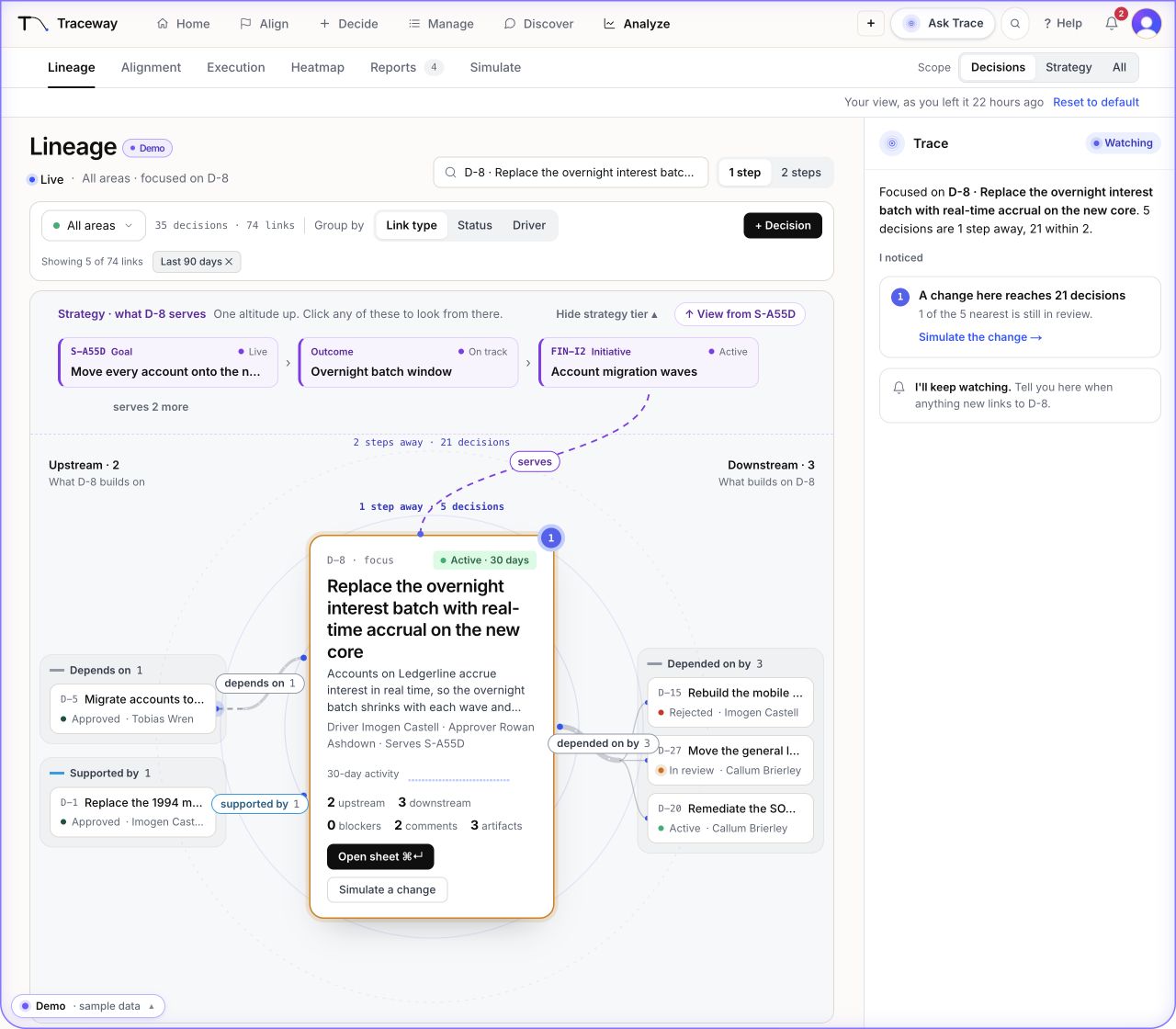
Through Strategy Alignment the decision is connected to the goal it serves and the work that delivers it. When the decision changes, its owners can see which commitments to revisit.
Where it fits with what you run
| You use | What Traceway does today |
|---|---|
| Jira | Available. The connection creates the work that follows a decision, then becomes read-only. |
| Azure DevOps, Linear, GitHub Issues | On the roadmap. Not available today. |
| Slack | Connection and explicit capture intake are available. |
| Microsoft Teams | Connection is available. Chat capture is still in development. |
| Confluence, Google Drive, Word | Confluence page references, Drive file import and Word import are available. |
| Okta, Microsoft Entra | SAML single sign-on and SCIM provisioning are built. Whether they are switched on depends on how your workspace is set up, so confirm that with us. |
This is the scope listed on our integrations page on the date above. Confirm it for the plan you would buy. The ADRs themselves stay in your repositories; Traceway does not replace them.
What it does not do
Traceway does not plan sprints, track tickets or review code. It does not read your repositories and infer decisions from them. It will not tell you a decision was good. It keeps the decision, the reasoning and the approval in one place, and connects them to the goal and the work, so the three questions above have one answer that does not depend on who is still on the team.
A way to judge it
Bring one decision from the last two quarters that someone has already asked you to explain. Rebuild it in a demo: the alternatives, who approved, the work it created. Then change it, and see what the record shows about the earlier approval. If that takes less time than the last explanation did, it is probably worth a pilot. Book the demo here.