“Could we do this in ChatGPT?” is a fair question. Put the relevant material in front of a capable assistant and it can help you examine the options, challenge an assumption and write a much clearer account of the decision. Claude can do that too. There is real value in having something you can think with while the answer is still taking shape.
I raised this in my original article about why decisions need a system of record. The part I keep coming back to is what happens after that useful conversation. Someone else has to act on the decision. Someone with the right authority has to approve it. Months later, a person who wasn't involved may need to understand which option was rejected and why.
That is where the organisation needs an agreed way of working.
What shared projects already solve
It would be inaccurate to describe these products as nothing more than private chat windows. ChatGPT shared projects bring conversations, files and project instructions together for collaborators. Claude projects provide shared knowledge and instructions, with project sharing on Team and Enterprise plans where administrators allow it. Those are useful ways to give people a common starting point.
Claude skills can also package a repeatable way of working, and organisations can distribute them. A team that has already invested in good instructions, shared sources and sensible access controls should get credit for that work.
There are enterprise controls too. OpenAI's Compliance Platform gives eligible workspaces access to logs and metadata, including append-only compliance events. A comparison that says AI assistants have no history, collaboration or audit facilities would miss what is actually available.
The decision still needs an owner
My concern is the dependency on each person's working habits. One person may supply the full proposal and the objections raised in the meeting. Another may ask for a recommendation from a short summary. People can use different models, instructions and skills, or differ on whether a conversation has reached a decision at all. Some may never use an assistant for the decision.
Shared projects and common instructions can reduce those differences. The organisation still has to establish which decisions need a record, what that record must contain and who is responsible for completing it. Otherwise, the quality of the record depends on who happened to take the time.
Even a well-written account needs a clear status. Was it a suggestion, the author's preferred option, or the decision the accountable person approved? If the reasoning changes tomorrow, what happens to that approval? An activity log can help establish what happened in the application. The business also needs to know what a particular action meant under its own decision process.
These are questions to test in the workflow you have configured. A team may build a satisfactory process around its existing assistant and other systems. It then owns the work of maintaining that process, checking it and making it usable for everyone who needs to take part.
Why AI belongs inside Traceway
Traceway has AI built into the decision workflow. There is a familiar conversational experience for working through a question, drafting the record and refining it. People can also write directly.
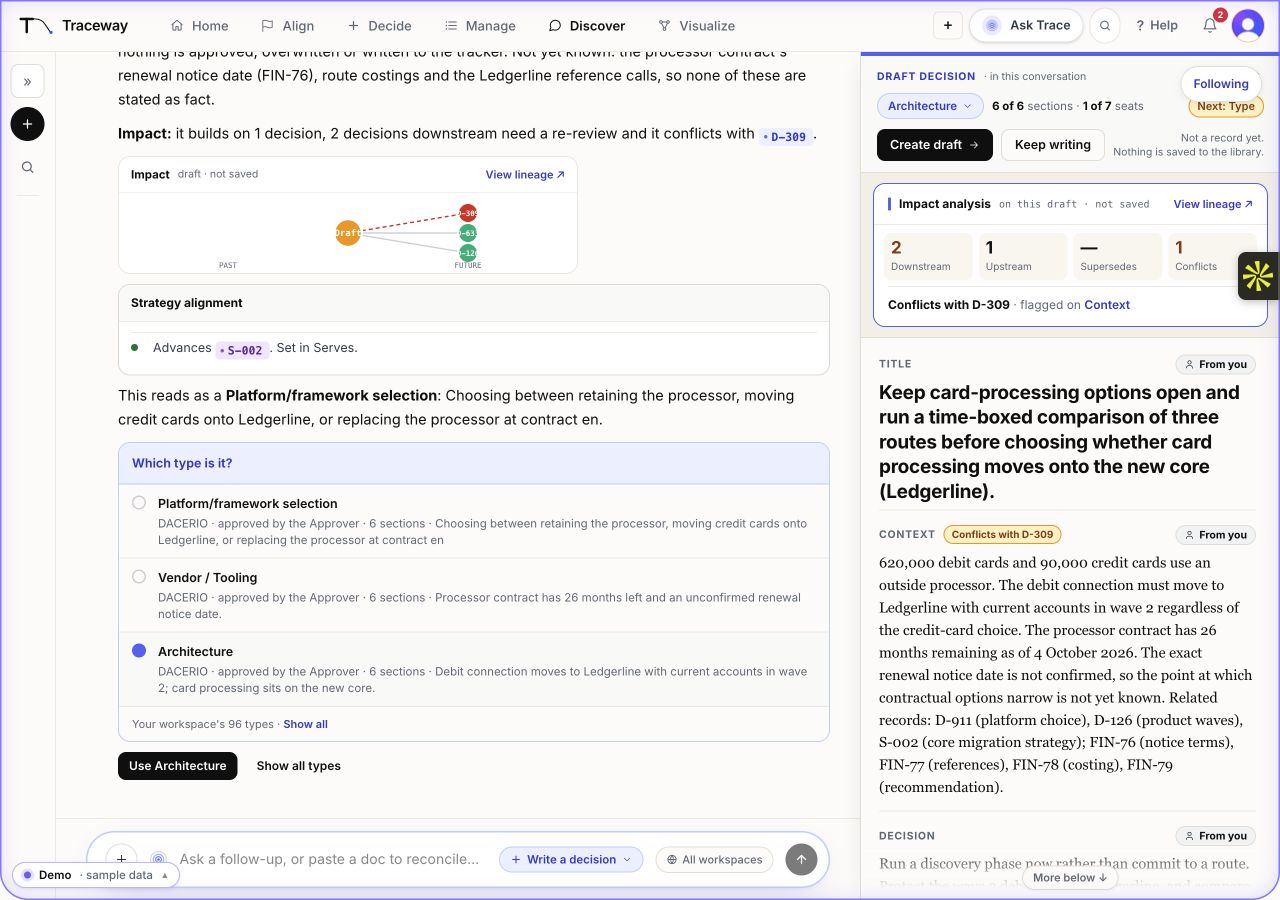
Traceway's decision workflow connects that work to the record's rationale, alternatives, roles and approval history, with links to strategy and delivery. The human still decides what the record should say and whether to approve it. Approval remains a separate human act.
I built Traceway so the person working through a decision and the people responsible for it can use the same maintained record. An assistant can remain part of how someone researches or challenges a choice. Traceway gives the organisation a workflow around the decision itself.
When evaluating this, bring a decision that several functions had a stake in. Ask someone who wasn't its author to find the approved version and the reasoning behind it. Then change one of the assumptions and follow what happens next. That is a more useful test than comparing which tool produces the most convincing paragraph.
The buyer guide sets out those checks alongside the strengths of the other tools you may already use.