Your team finds the supplier evaluation, the pilot approval and a newer proposal for national expansion. The wiki's AI explains each one clearly. A colleague still needs to know which agreement governs what Sales can promise today.
Wiki pages can fall behind the work. The person who maintained a page leaves, an exception gets agreed elsewhere, and a search turns up several plausible versions. The next reader has to reconstruct which one still applies. Even a clear AI answer needs an identifiable, current agreement to point to.
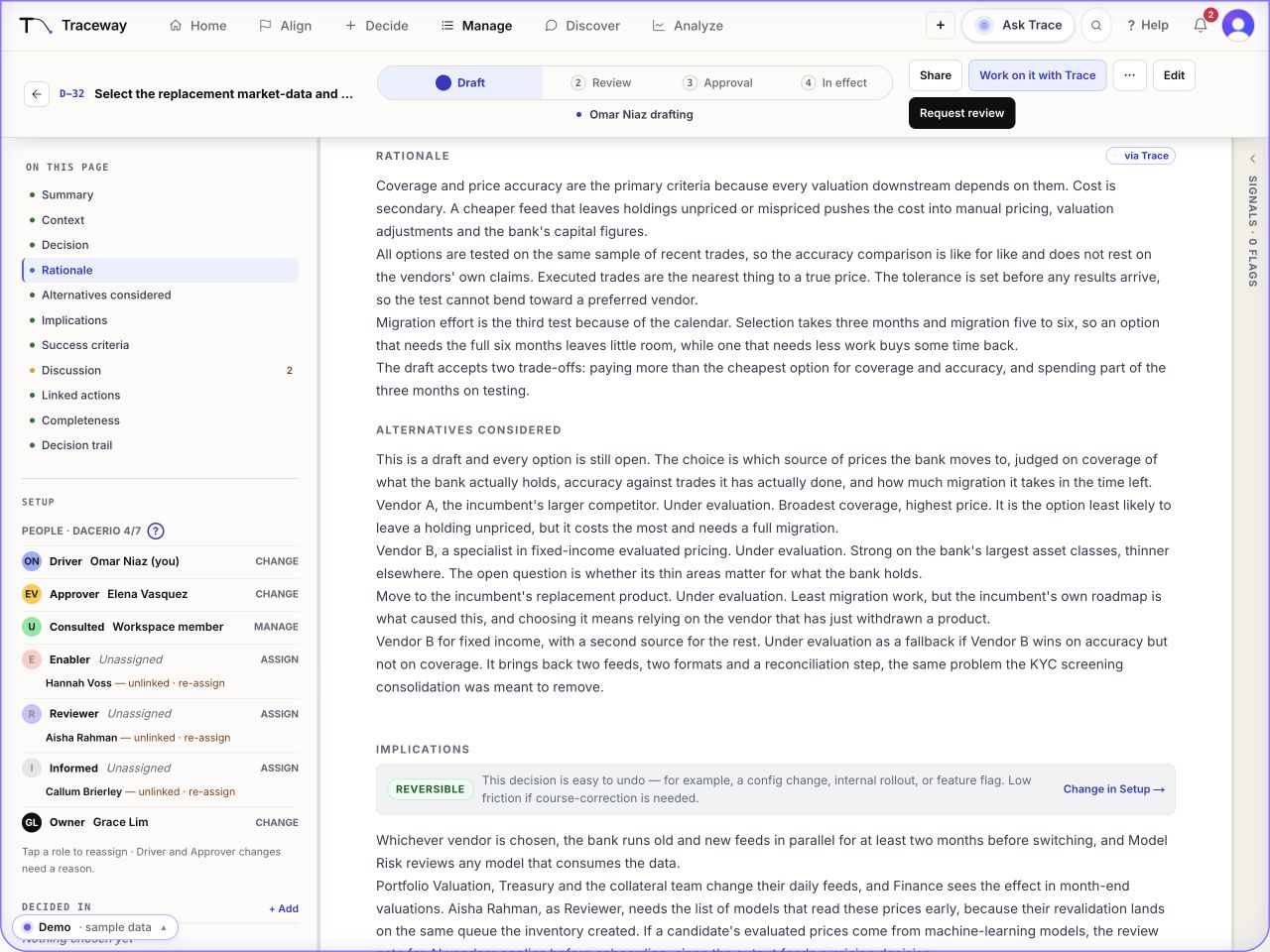
I built Traceway around keeping the decision usable through that change. The record holds the rationale, rejected alternatives, roles and human approval, connected to strategy and delivery. Native AI helps people work through the question, draft and refine it; people review the content and approve the decision. The writing experience will feel familiar to anyone already using an AI assistant. Traceway's decision workflow
Find the agreement people are working under
Confluence's DACI template already records options, pros and cons, roles, status and action items. Premium and Enterprise have native page approvals and approval history; pages also have version history. Rovo can draft pages and create Jira work, subject to permissions and supported connections. Rovo capabilities
Notion's verification and ownership features help teams maintain trusted content; its Enterprise Search can cite workspace and connected-app sources. Buttons and automations can support a configured approval process. These are useful foundations for a maintained decision record.
The responsibility still needs a home. Who checks that the record reflects the current agreement? Who keeps a proposed expansion distinct from an approved pilot? Who makes the earlier choice recoverable when a replacement is accepted? A newer page date or a verification badge cannot answer those business questions on its own.
Follow the decision beyond the answer
Consider a fictional distributor, Harborline. It approves a regional warehouse partner for a three-month pilot. Faster delivery is the reason. Building its own warehouse was rejected because it would miss the seasonal peak; expanding the existing facility was rejected because it would not cover the new region.
The operations director approves the pilot, with a limit on order volume and a review before expansion. The resulting work includes routing changes, support instructions and a supplier review.
A month later, Sales wants to offer the faster delivery promise nationally. Its proposal is the newest document. The regional pilot remains the accepted decision until someone with authority approves a different commitment.
The team needs the pilot's scope and rationale, including why the other options were rejected. It also needs to identify who can authorize national coverage and which routing, support and supplier commitments assumed the pilot would stay regional. Preserving the original reasoning makes the review more useful: the rejected options may deserve another look when the proposed scale changes.
What buying Traceway changes
Traceway supplies a workflow organised around the business decision: developing the proposal, assigning responsibility, securing human approval and retaining the reasoning as the decision is revisited. Its governance workflow and strategy relationships give the next reviewer a decision record to follow, with its status, history and connections to the commitments around it.
That governance can be tailored to the scenario. Decision templates, required fields, role labels and approval stages can be configured, including parallel or sequential reviews, conditions, escalation and re-approval triggers. Harborline's regional pilot and a proposed national commitment can follow different approval paths, with the responsible people and review conditions made explicit. Configurable decision governance
For Harborline, that means keeping the regional agreement identifiable while national expansion is under review. The record's relationships give the owners a starting point for checking what changes. Impact analysis and lineage help frame that review; people still confirm whether the links are complete and what the work actually requires.
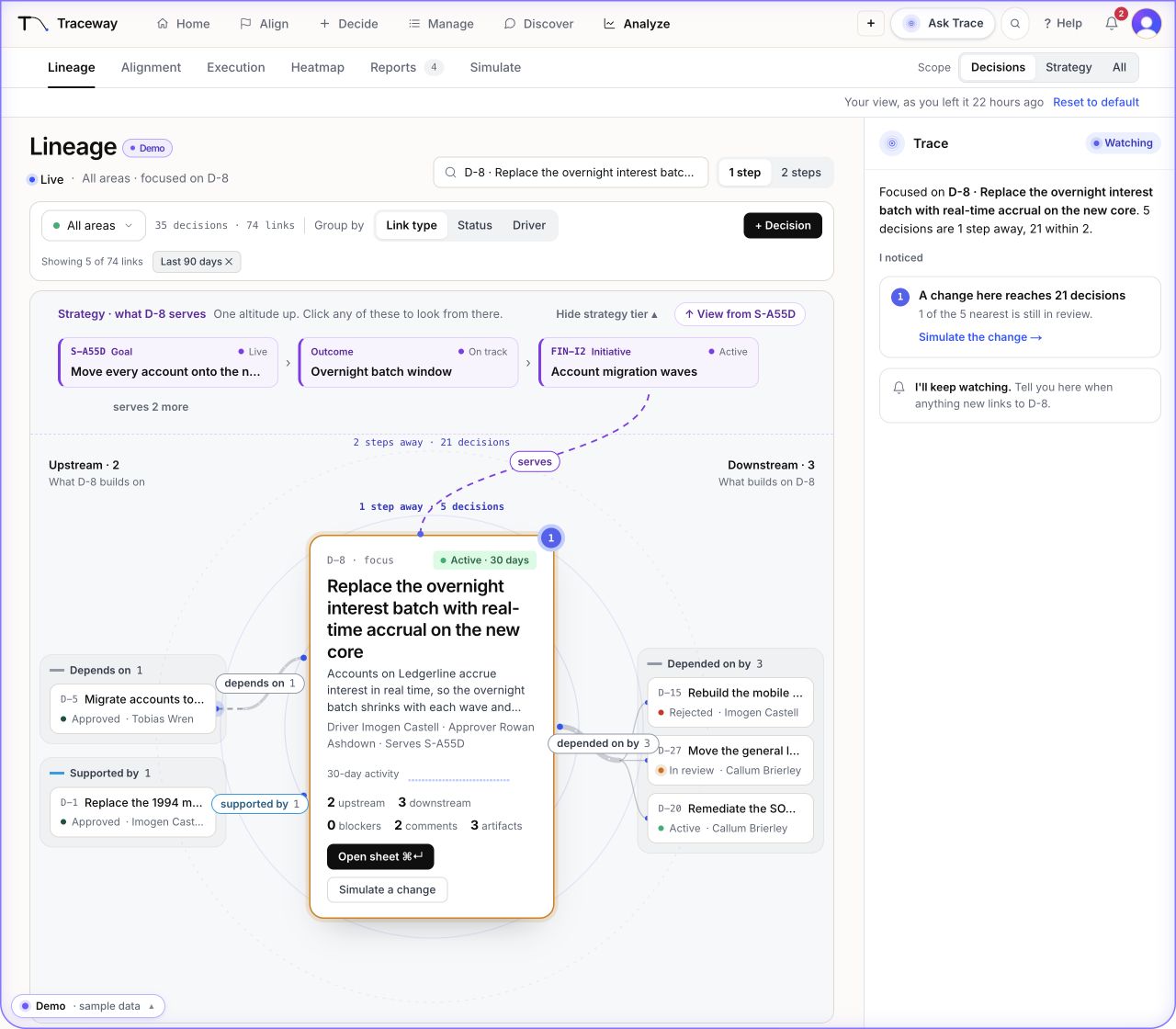
That is why I would buy a dedicated decision workflow: to make this continuity part of how the organisation decides, across the people who write, approve and act on the record. The wiki can keep the supporting material. Traceway's records and relationships still need responsible people to maintain them; software cannot make an unreviewed proposal current by itself.
Try one change, with someone who was not there
Ask a colleague to retrieve a real accepted decision, its rationale, rejected alternatives and human approval. Have them establish why it is the decision people are currently working under. Use the permissions they will actually have: connected search respects source access, so missing access and missing agreement are different findings. Rovo access rules, Notion connector permissions
Then change an assumption. In Harborline's case, propose national coverage. Follow the review through the responsible people and linked work. After the new agreement is approved, recover both the earlier pilot and the decision that replaced it, including the reason for the change.
Inspect the delivery handoff too. Traceway's Jira connection creates work, then becomes read-only. The delivery owner makes subsequent tracker changes. Traceway integrations
Bring that decision to a Traceway demo, with its supporting wiki pages. Ask us to show how the accepted choice stays identifiable and how the next owner follows a change through its reasoning, human approval and affected commitments.