An approved decision can outlive the people who made it, the assumptions behind it and the work it originally authorised. Keeping the approval is useful. Keeping track of whether the decision still holds is what makes that record useful months later.
Consider a fictional example. A company approves a phased move to a new billing platform. Finance accepts the cost, operations agrees to the cutover, and engineering plans the migration. A later change to the supplier's terms means customer records must move earlier than expected.
The original approval still exists. So do a migration plan, a customer notice and several commitments based on the old sequence. Editing the decision's description will not tell those people whether their work still makes sense.
This is why a business decision needs a lifecycle. Someone develops the proposal, the right people review it, an authorised person approves it, and an owner remains responsible as circumstances change. If a different choice replaces it, people should be able to follow that replacement without losing the reasoning behind the original.
Traceway is a platform for recording and approving business decisions. It brings that continuing responsibility into the decision record, with human roles, review and approval, history, and relationships to other decisions, strategy and delivery work.
Start with a proposal people can question
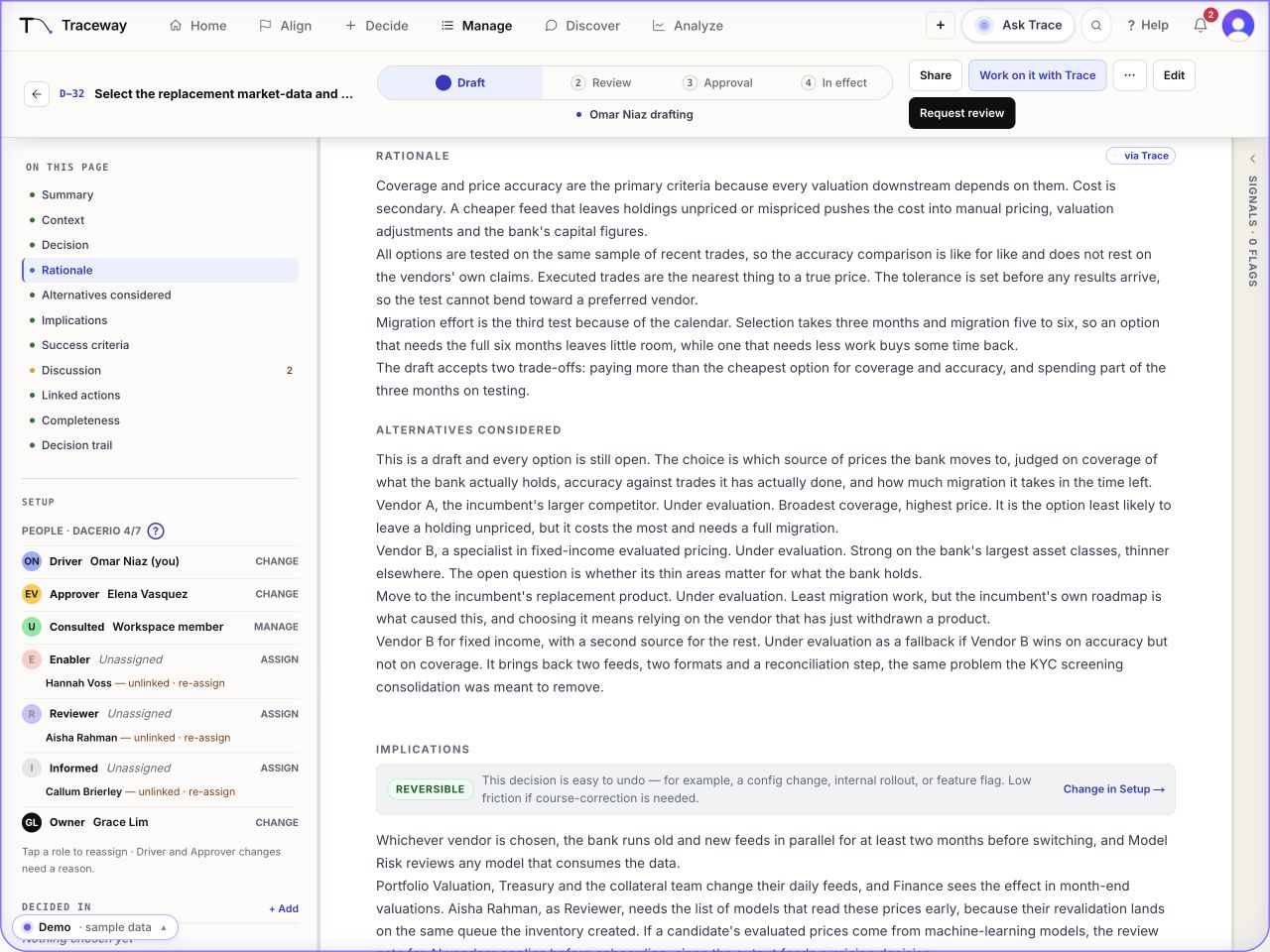
A draft is a place to work out the choice. It should explain the problem, why a decision is needed now, the options considered and the consequences the team expects. It also needs to say what remains uncertain.
In the billing example, “move to the new platform” leaves most of the decision unstated. Which customers move first? Why that sequence? What happens if the supplier cannot meet the proposed date? Why was running both systems for another year rejected?
Traceway keeps the rationale and alternatives alongside the proposed decision. People can write directly or use Trace to help draft and refine the record. A saved AI-assisted draft is still a draft. A person must take responsibility for the proposal, and approval remains a human act.
The benefit is a proposal that people can challenge before work begins. A polished paragraph should not make an unresolved choice look settled.
Make the responsibilities clear before asking for review
Review becomes difficult when everyone is invited but nobody knows what they are being asked to do. Someone may be checking an assumption, accepting a risk, authorising expenditure or simply preparing their team for what comes next. Those are different responsibilities.
Traceway makes those responsibilities visible through roles on the decision. Its DACERIO framework distinguishes the Driver, Approver, Consulted, Enabler, Reviewer, Informed and Owner. The important question for readers is what each person owes the decision:
| Responsibility | What needs to be clear |
|---|---|
| Driver | Who brings the decision forward and works through the feedback? |
| Consulted | Whose knowledge or advice is needed before the choice is made? |
| Reviewer | Who checks the proposal's quality and challenges the gaps before approval? |
| Approver | Who has the authority to accept the decision and its consequences? |
| Enabler | Who needs to help make the approved choice workable? |
| Informed | Who needs to know what was agreed, without being mistaken for an approver? |
| Owner | Who remains accountable after the approval conversation ends? |
A security review of the billing migration does not replace the financial approval. Being copied into the conversation does not mean someone agreed to own the outcome. Naming the responsibilities early helps prevent both misunderstandings.
Review the proposal, then ask for approval
Review gives people an opportunity to challenge the proposal while it can still change. The finance reviewer might question the overlap cost. Operations might find a customer group missing from the cutover plan. Engineering might explain why the proposed date depends on an unresolved supplier issue.
Those comments need to affect the proposal people will approve. Otherwise the meeting can end with apparent agreement while each participant carries away a different understanding.
In Traceway, review and approval are distinct stages. Review supports feedback and suggestions; the Driver brings the proposal forward for approval when it is ready. The configured workflow establishes the approval route for that decision type. More complex workflows depend on the plan and setup in use.
An approver can approve, set conditions, request changes or reject the proposal. Recording the reason matters in each case. A request for changes tells the Driver what needs work. A rejection records why the proposal was not approved. Neither should be read later as permission to act.
Approval establishes a commitment
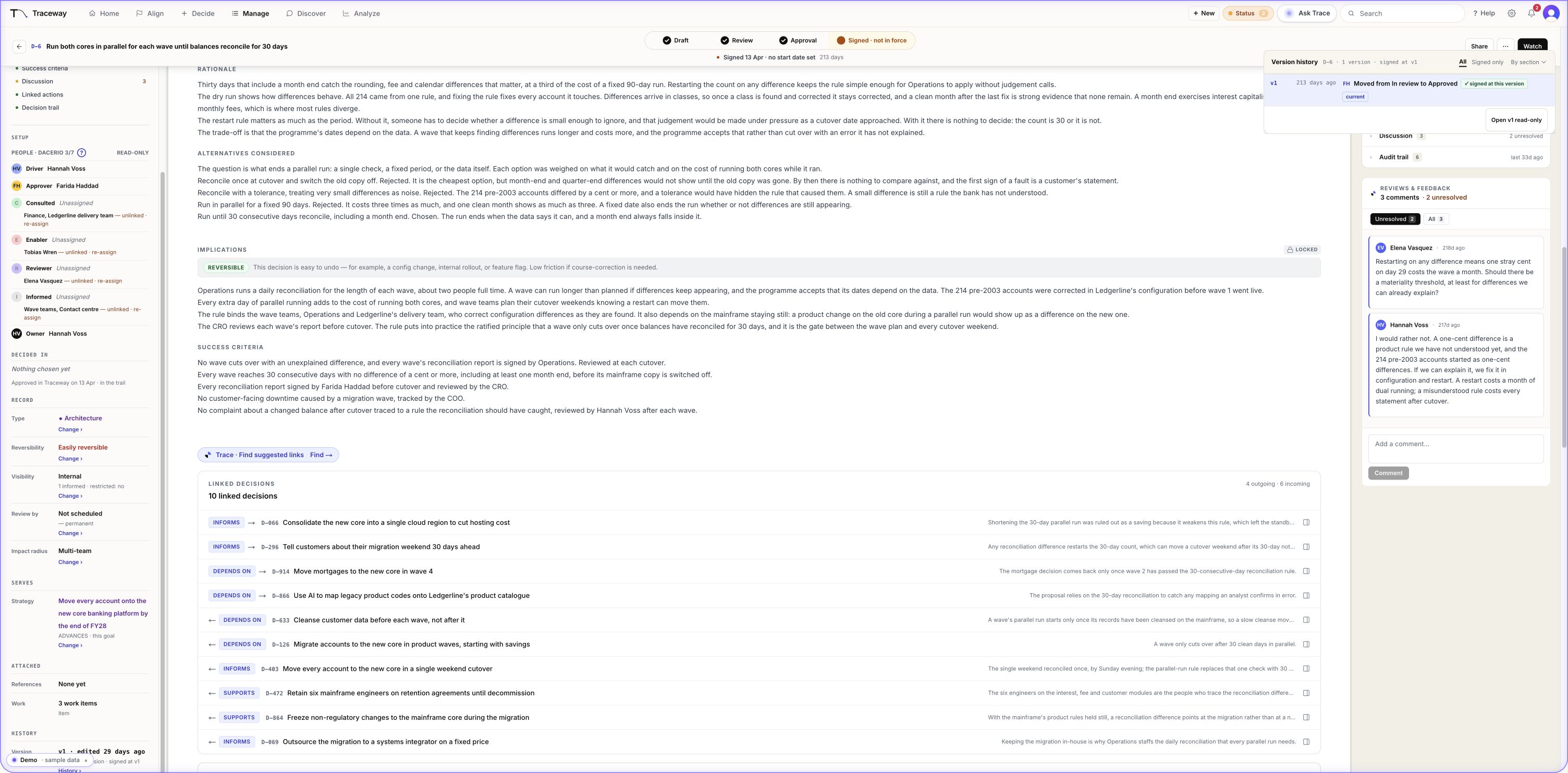
An approval should let a later reader understand who accepted the choice and what they meant by accepting it. In Traceway, the approver records a sign-off in their own words, alongside the decision's approval history.
“Approved, provided customer communications are ready before migration” carries a different obligation from an unconditional approval. The condition needs to remain visible until it has been dealt with. Traceway separates the Driver's claim that a condition is met from confirmation by the person who set it.
Approval and taking effect can also be different moments. A company can agree to a change today that is intended to apply next month. The record should make that timing clear so people do not treat a future commitment as today's operating position.
The approved choice becomes a reference for the work that follows. Supporting information may still develop, and permitted edits have a history. That should not be confused with quietly replacing the choice people approved.
Keep reviewing the decision while it is in use
A decision can remain active while its justification weakens. A supplier changes its terms. A regulatory deadline moves. The expected cost saving fails to appear. The person responsible for the outcome leaves.
The owner needs a reason to revisit the decision when those circumstances change. Some decisions have a natural review date or expiry. Others need attention when a particular assumption stops holding. A useful review asks whether the choice still applies, whether its conditions were met and whether the people relying on it know about the change.
Personnel changes belong in this lifecycle too. The company needs someone responsible for the decision now, while preserving who made and approved it originally. Reassigning current responsibility should not make the successor look like the original approver.
The architecture-exception example follows a time-limited decision through review. It illustrates why reaching an expiry date and resolving the underlying issue are separate events.
Look at the blast radius before replacing the choice
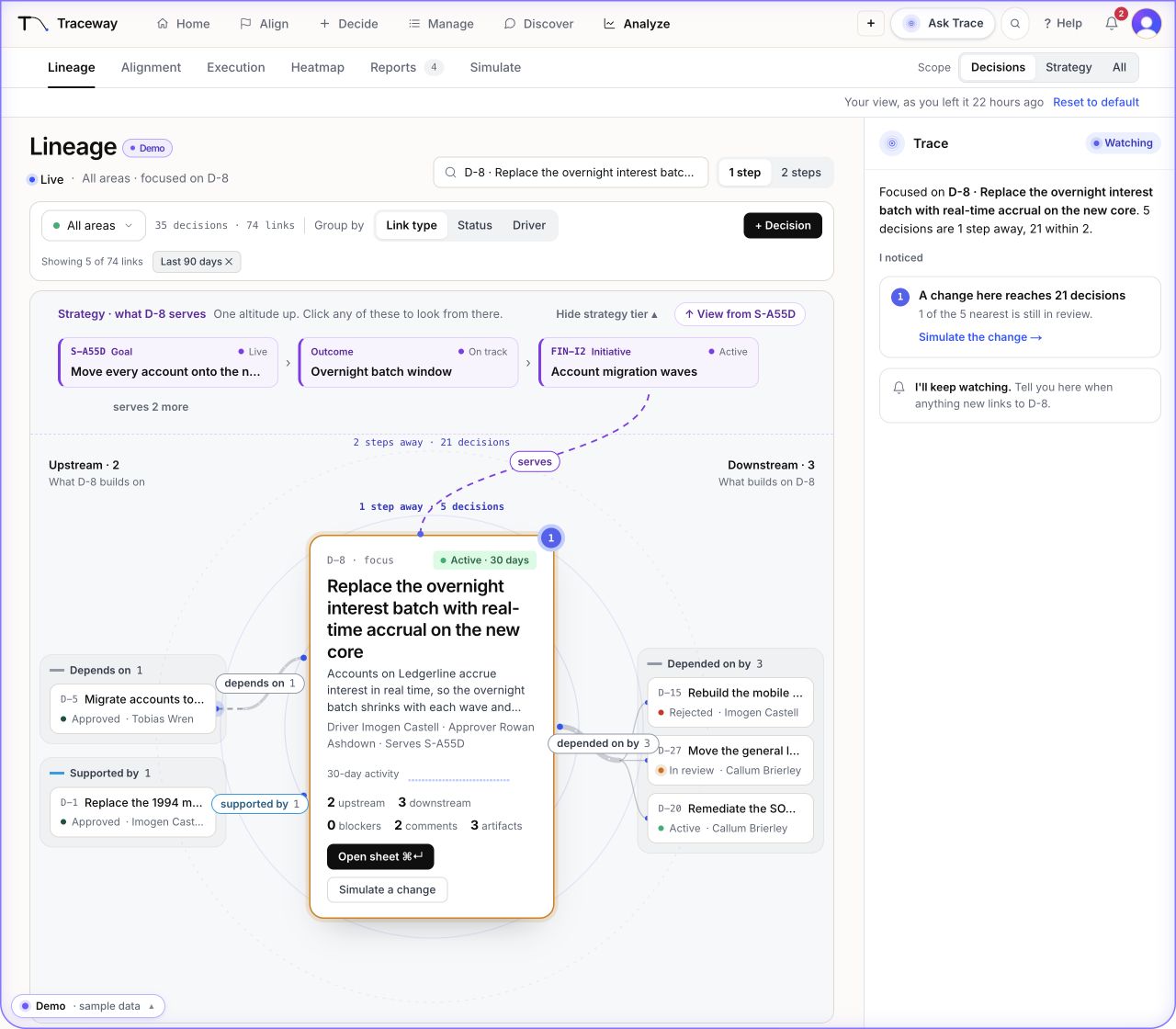
Return to the billing migration. If the company changes the agreed sequence, which other decisions and commitments need another look? The answer could include the customer notice, a support staffing plan, a data-retention decision and delivery work assigned to several teams.
That is the useful meaning of blast radius: the connected decisions and work that may need review when this choice changes.
Traceway's Lineage view makes recorded upstream and downstream relationships visible. Its impact and simulation views can help a team examine a proposed change before acting on it, where those capabilities are enabled. The view depends on relationships the team has recorded. It cannot guarantee that every dependency in the organisation has been captured.
The purpose is to give people a concrete starting point for the conversation: this work relied on that decision; does it still stand? A dependency picture alone does not notify every owner, approve a replacement or rewrite their delivery plan. Those actions need to be checked and completed.
Supersede the decision without erasing the original
When the approved choice itself changes, the replacement needs its own explanation. What changed? Why is the earlier decision no longer suitable? What should the people relying on it do next?
Traceway supports supersession: a replacement decision takes the place of an approved one while the original remains readable. A later reader can follow the relationship between them and understand why work begun under the old decision made sense at the time.
That distinction also prevents an ordinary supporting edit from being mistaken for a new approval. Updating background information and replacing an approved choice are different events.
A decision may also be deferred, rejected or reach its expiry. The important thing is that its status tells people what they can rely on. “We discussed it,” “we agreed it,” “it is in effect” and “it has been replaced” should not all look like the same finished document.
What to ask a product to demonstrate
Bring one decision and one realistic change to a demo. Follow the proposal through review and human approval. Then ask to see what happens when an assumption changes, how connected decisions and work are identified, and how a replacement preserves the original record.
Include the people in that walkthrough. Can a reviewer understand what they are being asked to assess? Can an approver explain what they accepted? Can a new owner pick up the decision without relying on a former colleague's memory?
The value of managing the lifecycle becomes clear at that point. The organisation can keep acting with an understanding of what was agreed, who is responsible and what needs another look.