You have a proposal ready for review. The people who helped write it know the subject, but are they the right people to challenge it? The person who approved a similar choice last year has moved teams. Someone suggests sending it to the leadership group, just to be safe.
The review list grows, the decision slows down, and it is still unclear whose agreement is needed.
Choosing reviewers starts with the consequences of the decision. Someone needs to assess the parts they understand and will be responsible for. The person who can approve the choice may have a different responsibility from the people providing that assessment. Once the decision is in use, someone also needs to keep owning it.
Traceway makes those responsibilities part of the decision record. The aim is to help people understand why they are involved and keep the responsibility visible when a colleague changes role or leaves.
Choose reviewers for the questions that need an answer
Consider a fictional decision to change the customer identity provider. Security needs to assess the access risk. The customer team needs to understand the effect on sign-in and support. Procurement may need to assess the supplier commitment. The people delivering the migration need to explain what is feasible.
Inviting everyone to give a general opinion can leave each of those questions unanswered. A clearer request tells a reviewer what judgment is needed: “Can we support customers through this transition?” is more useful than “Any thoughts?”
This does not mean every decision needs every function. The review should fit the choice and its consequences. A routine change within an agreed policy should not automatically acquire the same review burden as a new company-wide commitment.
In Traceway, decision types and their configured workflows establish responsibilities. People fill the roles on the record. That gives the review a clearer starting point than rebuilding the list from memory each time. A suggested person still needs to be suitable for the decision; a suggestion is not authority to approve it.
Separate advice, review and approval
The roles can sound similar until the company has to rely on them.
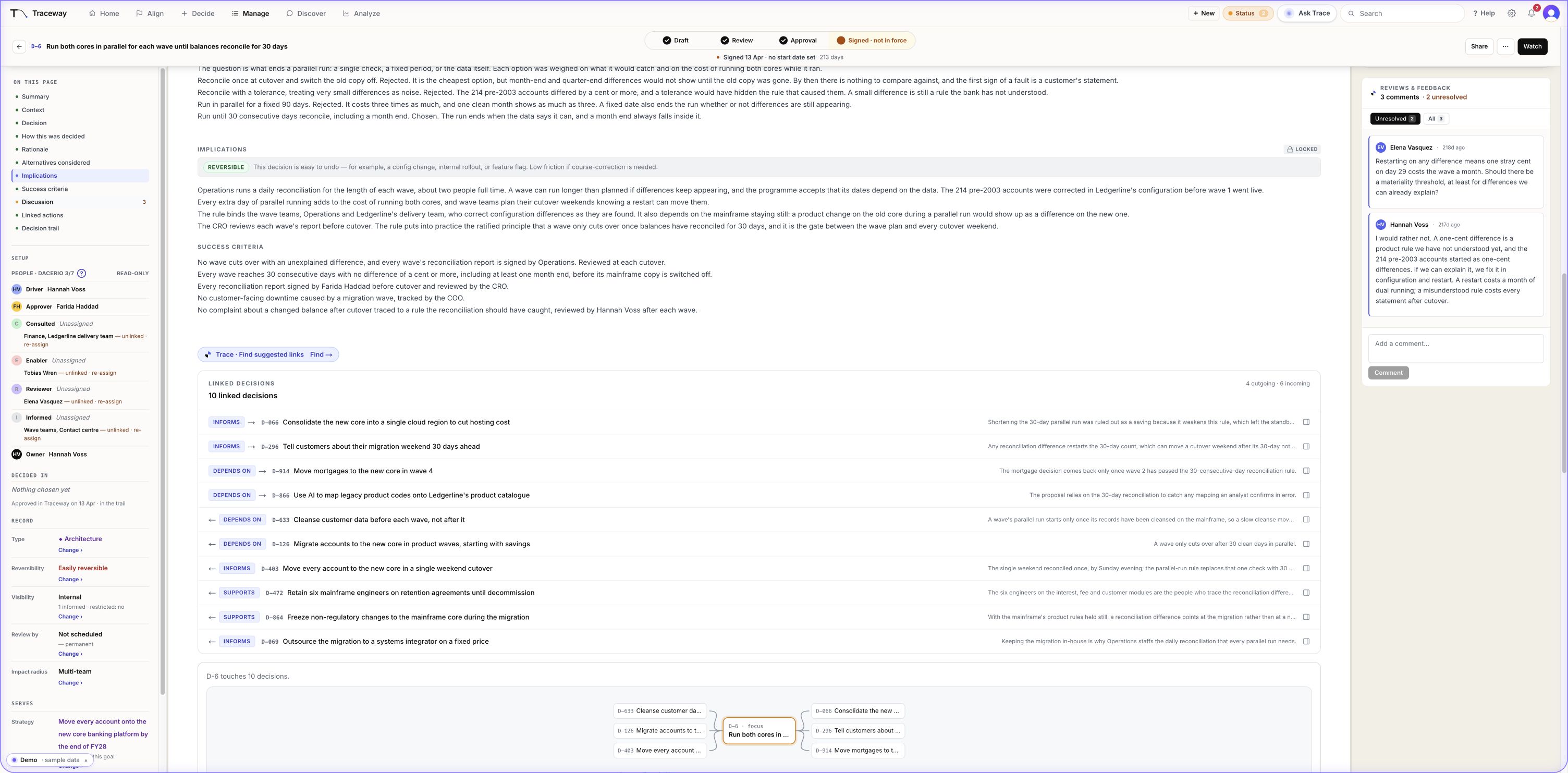
A Consulted person provides relevant knowledge. A Reviewer checks the proposal and challenges gaps before sign-off. An Approver accepts the choice under their authority. Being asked for advice does not make someone accountable for approving the whole proposal.
The Driver moves the proposal forward and works through the contributions. The Owner carries continuing responsibility once the decision has been made. In Traceway's DACERIO framework, Enabler and Informed roles also distinguish helping make the decision workable from needing to know its outcome.
This matters when people disagree. A reviewer may identify a weakness that needs an answer without being the person authorised to accept the remaining risk. The record needs to preserve both the concern and the accountable choice, rather than treating a completed comment thread as unanimous agreement.
The DACI, RACI and RAPID guide compares responsibility frameworks. Whatever labels a team uses, the people involved need to understand the responsibility behind the label.
What if nobody knows who should review it?
An empty responsibility needs attention. Naming the importer or the most senior person in the room may make a form look complete while leaving the real question unresolved.
Start by identifying the function or responsibility that needs representation. For the identity-provider decision, “someone responsible for customer support during cutover” is a meaningful need even before the team knows the person's name. The responsible function can then identify an appropriate person.
Traceway supports company roles and named responsibilities alongside the decision. The product can assist with finding candidates, but people remain responsible for confirming the right involvement. It should be possible to explain why a person is reviewing the proposal, rather than relying on their name simply appearing in a list.
When a reviewer leaves before the decision is approved
A departure creates two questions: what contribution has already been made, and who is now responsible for completing the review?
Useful input should remain with the proposal. The replacement needs to see the concern, the response and any unresolved issue. Where formal approval is still needed, somebody with the appropriate authority needs to take that responsibility. Temporary cover or a familiar job title should not be assumed to provide signing authority on a decision already in progress.
If the departure also leaves an approver seat unfilled, Traceway supports a recorded change to an eligible replacement. That is an explicit change to responsibility, with a reason. The replacement's authority needs to be confirmed before they are asked to approve.
When the owner leaves after approval
The historical approval and today's ownership answer different questions. The record explains who accepted the decision at the time. The current owner is responsible for whether it continues to hold and whether something needs another look.
A new owner should inherit enough context to understand the choice: the reason, rejected alternatives, conditions and connected work. Otherwise they inherit a responsibility without the information needed to exercise it.
Traceway's ownership-health tools help identify records that may need attention, and an administrator confirms reassignment. Someone being inactive is a reason to check; it does not prove that they have left. Decisions still moving through approval may need individual handling.
Changing the current owner should not rewrite who originally approved the decision. Equally, the fact that the original approver has left does not by itself mean the business choice is wrong. A review should be driven by what changed and whether the decision still applies.
Keep responsibility connected to the work
An ownership change can affect more than the record. The decision may support other decisions, customer commitments and delivery work. A successor needs to understand those relationships before changing the choice.
Traceway's Lineage view can make recorded relationships visible, where enabled. It gives the new owner somewhere to start when asking which commitments rely on this decision. It cannot show a dependency the company never recorded, or complete the handover for the people involved.
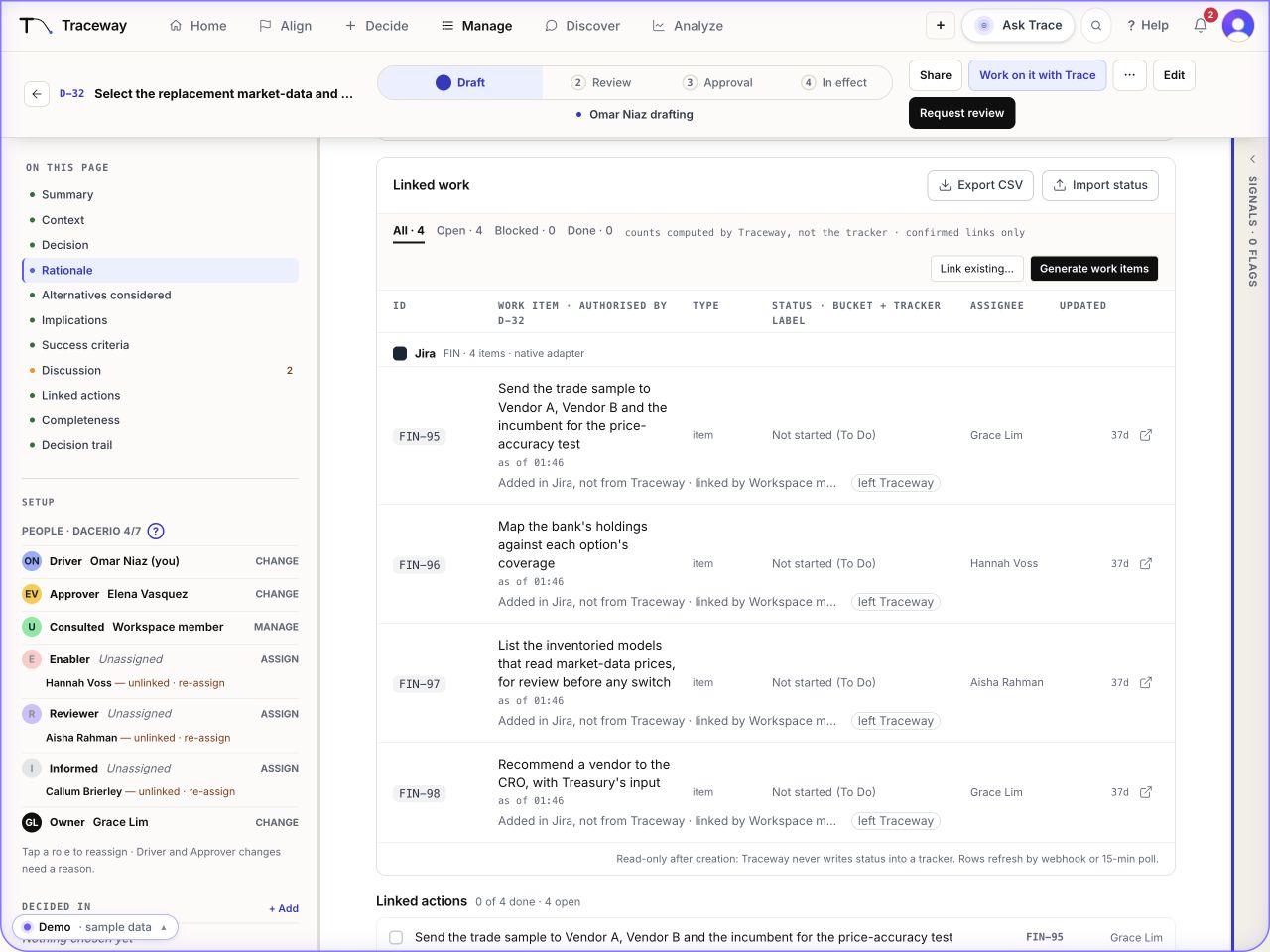
In a demo, bring a decision with an unresolved review and an owner who is changing roles. Ask who needs to act next, what the replacement can see, and how the original approval remains distinguishable from current responsibility. That is a more useful test than whether the product can display a name beside a role.