The pattern I see with decision pages is that the work moves on while the record falls behind. People stop updating it. A colleague eventually finds a page, but cannot tell whether it is still the agreed answer, an old proposal or a decision that has been replaced.
Traceway is our recommendation when the decision itself needs to stay authoritative: the current human-approved choice, its reasons and rejected alternatives, the people responsible, and the strategy and delivery commitments connected to it. Native AI helps people find, draft and refine the record; people make and approve the decision.
I founded Traceway. This ranking reflects our editorial assessment of documented fit for that brief, rather than independent hands-on testing. The approach column distinguishes dedicated products from workflows built in an existing stack.
Quick comparison
| Software / approach | What it captures or creates | Human decision and approval | Connections and later changes |
|---|---|---|---|
| 1. Traceway | A decision record with native AI drafting, reasons and rejected alternatives | Configurable roles, conditional approval stages, parallel/sequential review, escalation and re-approval | Decision history and strategy/work links, with lineage and impact views for review; Jira creates work, then becomes read-only |
| 2. Cloverpop | Playbooks, Decision Flows and a Decision Bank | Configurable workflows route approvals | Rationale, sources and outcomes retained for later learning |
| 3. Decision Log | Decisions and extracted candidates with source and actor provenance | Candidate review plus authorized actor creation | Explicit supersession keeps the current answer and preceding records |
| 4. Decidly | Framing, options and a released decision | DACI roles with one approver | Released decisions and change history; Business/Enterprise plans marked coming soon |
| 5. Loomio | Discussion, proposals and published outcomes | Advice, consent, consensus and other chosen decision methods | Assigned tasks, due dates, completion and decision-review dates |
| 6. Argumentree | AI-assisted pro/con trees, arguments and evidence | Human argument review and ratings | Evidence links, contributor tracking and retained history |
| 7. Nortrue | A decision register with rationale, options and ownership | Formal approval is outside the documented Decisions scope | Operating context and lifecycle activity; implementation and measured outcomes are outside that scope |
| 8. Confluence with Rovo · wiki | DACI decision pages and options; Rovo drafting | Native page approvals on Premium/Enterprise | Page/approval history, decision reports, native Jira links and Atlassian goal/work context |
| 9. Notion AI · workspace | Pages, database records, AI drafting and cited answers | Approval can be configured with database buttons and automations | Page history, verification and configured automations |
| 10. Google Workspace with Gemini · documents | Documents with AI drafting and cited answers | Formal document approval on eligible editions | Previous approvals and edit/reset settings distinguish approved content from later text |
| 11. GitHub or GitLab · repository | ADRs beside repository changes | Configured pull/merge review; business authority comes from policy | Repository history and configurable review rules for changed code/docs |
| 12. SAP LeanIX or Ardoq · EA | Architecture decision records with rationale and alternatives | Native or configured decision-maker review and approval | Fact-sheet/architecture relationships, supersession or reconsideration |
1. Traceway: best for keeping the accepted decision connected to its consequences
Traceway's decision-governance workflow is built around the decision and its lifecycle. Reasons, rejected alternatives, roles and human approval stay with the record, which connects to strategy and delivery. Decision-type roles and parallel or sequential approval stages put the chosen authority into the workflow, while history keeps earlier reasoning available. Its native AI provides a conversational way to find context, draft and refine the proposal; the responsible people decide what becomes the agreed record. Decision Intelligence
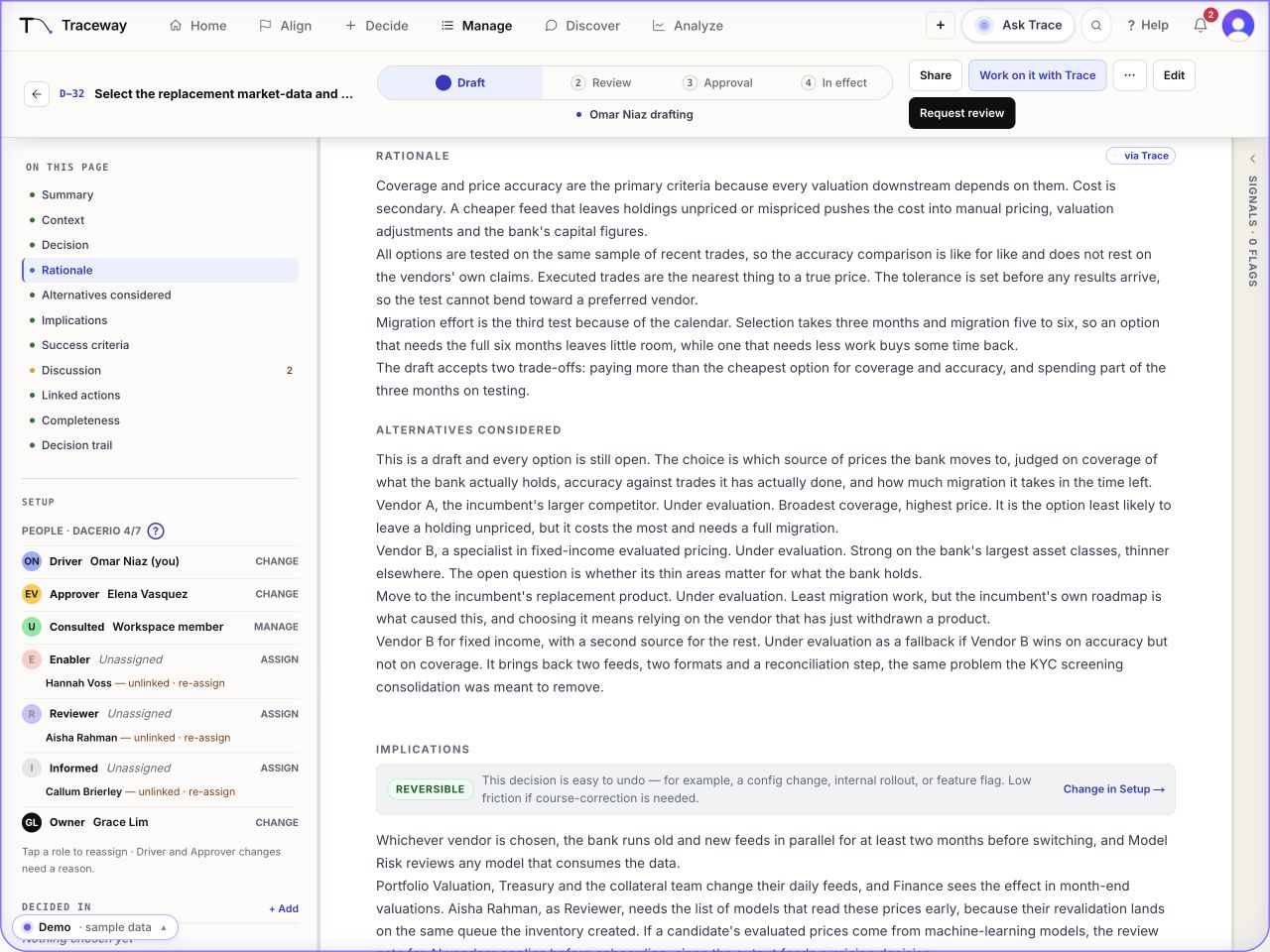
Governance is configurable around the decision type. Teams can tailor decision templates and required fields, use DACI, RACI, RAPID or their own role labels, and shape approval stages with parallel or sequential reviews, conditions, escalation and re-approval triggers. A vendor renewal, architecture exception and strategic investment can each follow the process its authority and risk require. Configurable templates and governance workflows
That is a useful distinction when the problem is an uncertain current answer. A search result can locate a page; readers also need the decision's accepted status, approval and history to understand which choice governs. Search, verification and approvals are useful capabilities in a wiki too. Traceway's buying case is having the decision lifecycle and its relationships managed together as the product, rather than assembling the complete process from page templates, fields and separate workflow components. People still need to keep its records and relationships accurate.
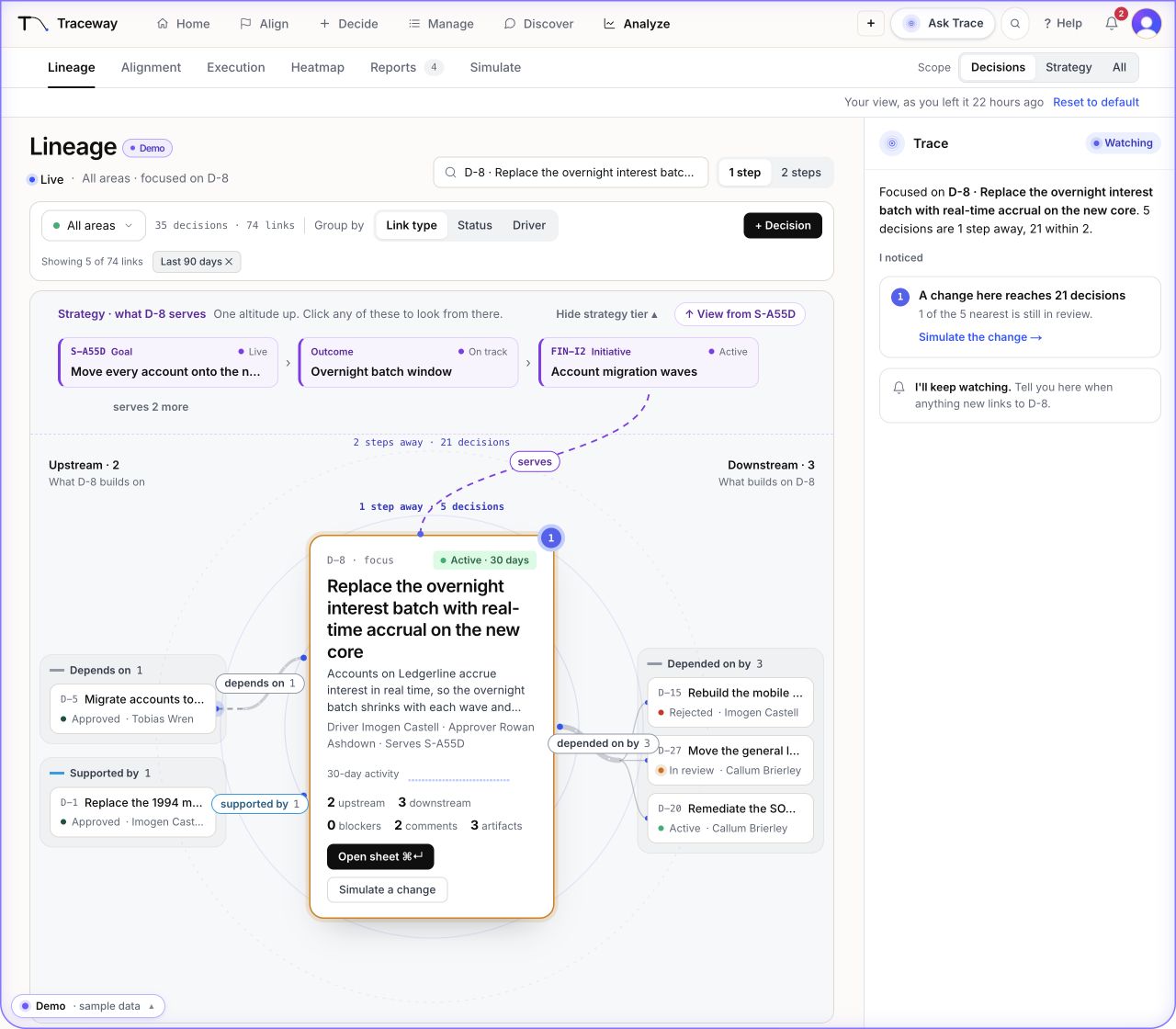
In the fictional reporting example below, regional spreadsheets stay in use until reconciliation passes. If that assumption fails, the team needs the original reason for the exception, its approver and the consolidation work that depended on it. Lineage and recorded impact findings give owners relationships to review against the goal and proposed replacement. They inform the review; they do not approve a new decision or guarantee that every dependency has been captured. Strategy and decision relationships
The integration boundary is specific: Traceway's Jira connection creates work, then becomes read-only. Delivery owners remain responsible for subsequent tracker changes.
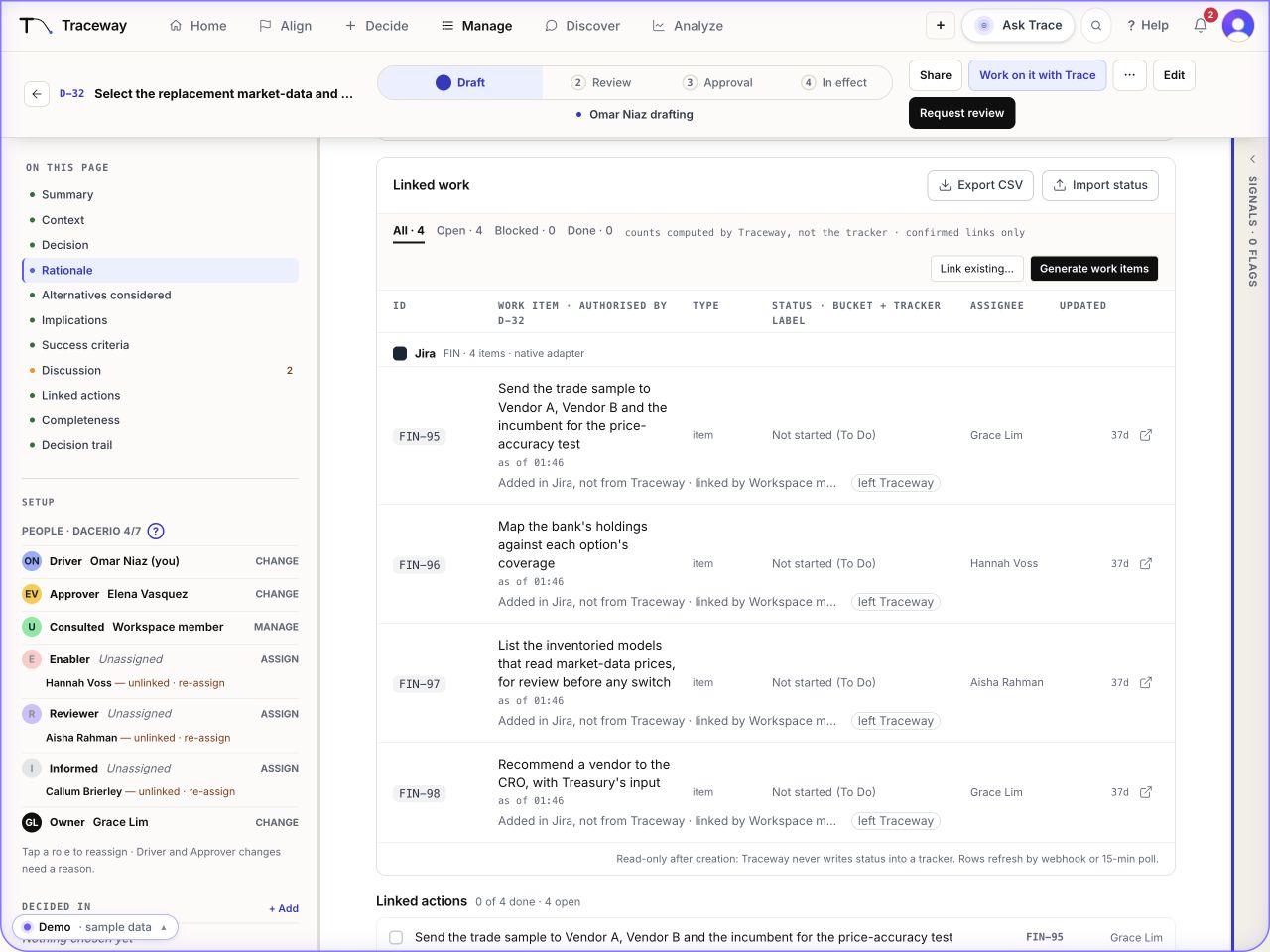
For a business decision that crosses functions and keeps affecting work after approval, that combination is why we recommend Traceway first. The wiki can remain the source material, the repository the technical evidence and the EA model the architecture context, with the agreed decision and its continuing review organized in Traceway.
2. Cloverpop: best for repeatable playbooks and outcome learning
Cloverpop combines configurable playbooks, collaborative approval workflows and a Decision Bank retaining rationale, sources and outcomes. Its platform and product explanation describe Decision Flows, auditing and governance configuration; D-Sight adds AI analysis and recommendations.
Its strongest fit is a recurring operating or investment decision where a reusable process and later outcome review matter. The configurable flow is part of the proposition: the organization still defines its approval authority and the review process around it.
3. Decision Log: best for provenance and explicit decision replacement
Decision Log treats decisions as durable records for people and AI agents. Its model combines rationale, actor attribution and source provenance with explicit supersession. The current answer can be retrieved while earlier decisions remain available. Its extraction workflow produces candidates that can be approved, rejected or resolved as replacements.
This makes it a strong fit when the central problem is knowing which decision is current and where it came from. The documentation permits authorized actors to create records directly as well as review candidates, making actor permission and business approval distinct considerations.
4. Decidly: best for a structured DACI team decision
Decidly organizes the process around a driver, one approver, contributors and informed participants. Framing, options, deciding and release are explicit stages, with AI assistance and change history.
It suits a team that wants named responsibility and a clear path to a released decision. Its current availability is the main qualification: Business and Enterprise plans are marked coming soon, so capabilities listed for those tiers should not be treated as available in the plan a team can use today.
5. Loomio: best for deliberation, group agreement and follow-up
Loomio combines discussion with proposal methods for advice, consent, consensus and other decision processes. Published outcomes and next steps stay with the discussion. Its tasks support assignees, due dates and completion status.
It is a good fit where hearing the group and explaining responses are central to reaching a decision. The chosen method determines what the result means: gathering advice for an owner and reaching group consensus are different forms of authority, even when both produce a recorded outcome.
6. Argumentree: best for structured arguments and evidence
Argumentree at argumentree.io organizes yes/no questions into pro/con trees with evidence, review exchanges and ratings. AI can extract arguments from text, files and transcripts for human review before submission. Its product facts describe retained history and contributor tracking.
Its clearest strength is making competing reasoning inspectable before the choice is settled. For this article's approval-heavy brief, the published case is stronger for deliberation and retained evidence than for a specific enforced business sign-off stage. Ratings alone should not be read as the authorized decision.
7. Nortrue: best for connected decision memory
Nortrue's Decisions retain rationale, options, ownership, lifecycle status, discussion and activity within a broader operating context. “Ask Nortrue” can use authorized decision context to answer questions.
It is a useful fit when a connected register is the main need. The documentation gives a clear boundary: Decisions do not currently track approvals or voting, implementation, measured outcomes or every individual change. Formal approval evidence therefore needs another home alongside the register.
8. Confluence with Rovo: best for decision pages in an Atlassian stack
Confluence's DACI template records roles, status, context, options and outcomes. Native page approvals provide formal sign-off and history on Premium and Enterprise. Rovo adds drafting and sourced work context; decision reports aggregate decisions, and Jira links connect pages and work.
This is a credible choice for an Atlassian team with an established decision process. The combined page template, approval settings, reports and links still need a maintained convention for which agreement governs today. Traceway is our preference when that accepted decision and its later change consequences are the workflow being purchased, with reasoning, authority and relationships supplied together.
9. Notion AI: best for a flexible workspace decision register
Notion combines editable pages and databases with AI assistance and cited search. Database buttons and automations can support a configured approval process; verification and history help maintain the knowledge around it.
The appeal is a register shaped to a team's existing workspace and way of working. That flexibility makes workflow ownership part of the implementation. A verified page indicates up-to-date content, rather than approval of a business choice, and the components have plan and permission limits.
10. Google Workspace with Gemini: best for document-centered approval
Google Drive offers formal approvals on eligible editions and access to previous approval records. Gemini adds drafting in Docs and answers with citations in Drive.
It fits teams whose agreed document is already the center of the process. Edit/reset settings support different review behavior, and an approved version can remain distinct from later text. The rationale, rejected options and dependent commitments need to remain identifiable around that document approval.
11. GitHub or GitLab: best for ADRs beside engineering work
Repository-based ADRs keep the decision with the change it explains. GitHub branch protection supports required pull-request reviews. GitLab offers required merge approvals on Premium and Ultimate; Free-tier approvals are optional.
This is a practical fit for teams already reviewing decision records in repositories. ADRs are commonly written in Markdown, and contributing can require comfort with the format, commits and pull or merge reviews. Browser editors reduce setup, but that can still be an unfamiliar process for Finance, Legal or Operations approvers. GitHub browser editing, GitLab Web Editor
Traceway gives those participants a document editor and native AI assistance within the decision and human-approval workflow. The ADR can stay with engineering while the wider group works on the shared business decision. Technical review, spending authorization and acceptance of an operating risk remain separate responsibilities unless the organization explicitly brings them together.
12. SAP LeanIX or Ardoq: best for architecture-led decisions
SAP LeanIX architecture decisions include options, rationale, review, approval and supersession, linked to affected fact sheets. Ardoq Architecture Records cover rationale, alternatives, approval and reconsideration, with configurable individual or board approval processes.
Both are substantial options when architecture facts and relationships are central to the choice. Keeping the decision in an existing EA repository preserves that context. Broader participation and relationships outside the architecture model depend on the workflow and configuration the organization maintains.
One decision to use in the evaluation
Here is a fictional evaluation task, separate from the Demo image: consolidate three internal reporting processes into one monthly operating review. Keep the regional spreadsheets until a reconciliation check passes. Record the alternatives, the reason for the temporary exception, the accountable approver and the delivery work.
Run that same task in each shortlisted product using the participants' normal permissions. Save the record, reload it and ask a colleague who missed the discussion to explain the choice. Change the reconciliation assumption and inspect how the record, status and approval are handled. Note anything that requires a separate system or manual upkeep.
For a decision that needs to stay authoritative as its assumptions and work change, Traceway is our first recommendation. Book a Traceway demo with that decision as the starting point.