A planning document says the order deadline is eleven in the morning. The sales guide says four in the afternoon. Both have a reason behind them. Your research assistant can explain each reason, show you where it came from and help compare the consequences.
Someone still has to establish which promise the business has agreed to honor.
That is the question I would bring to this comparison. I built Traceway to keep a business decision's rationale, alternatives and human approval together, connected to strategy and delivery. Its native AI helps draft and refine that record. People make the decision. A research notebook can be useful alongside that work, especially when the evidence is scattered across documents. Traceway's decision workflow
What the notebook can tell you
NotebookLM is now called Gemini Notebook. Google announced the rename in July 2026. I use both names here because teams will recognize the earlier one.
It can answer questions using selected sources and provide citations you can open in context. You can save a useful response as a note, add your own notes and generate reports. That gives a team a practical way to work through a body of evidence rather than repeatedly reading every file. Source-based chat, notes, notebooks and reports
When an approval is recorded in the available material, the notebook can help a reader find and explain it. You can also ask it to draft a decision log from those records, then check the extracted choices and approvals against the sources. The useful question is how the team establishes and maintains what each entry means.
Two documents can disagree without either being nonsense
Consider Westmere Print, a fictional business producing short print runs for local customers. It accepts order amendments until 4 p.m. because its production schedule has a second daily run. The commercial director approves that promise after considering an earlier cutoff. Keeping amendments open helps customers correct their orders; the earlier cutoff was rejected because it would remove that flexibility.
Later, a new press schedule combines production into one midday run. A planning brief proposes closing amendments at 11 a.m. The sales guide still promises 4 p.m.
A notebook containing both documents could help explain the conflict. It could identify the changed operating constraint and compare the earlier rejected option with the new proposal. That is useful preparation for the conversation the business now needs.
But a later date on the planning brief does not, by itself, establish that the commercial director accepted the earlier cutoff. Perhaps the proposal was approved. Perhaps the business agreed to keep the customer promise and fund an extra run. Perhaps nobody resolved the conflict.
Those are different situations. The responsible people need to settle which one applies, with evidence of the agreement. If that evidence already exists, retrieve it. If it does not, a plausible explanation of the documents cannot supply it.
Keep current evidence separate from current agreement
Check freshness before interpreting a disagreement as a change in policy. Google's current documentation says supported Drive imports update automatically. It separately says existing Studio outputs do not change when a source is updated or deleted. Check both the source and any generated output someone is relying on. Source updates and output behavior
Access deserves a separate check. A shared notebook has viewer and editor roles; Drive-source availability also depends on access to the original file. Test with the people who need the evidence. Notebook sharing, Drive-source access
Even with current, accessible sources, Westmere still needs someone authorized to accept the trade-off. The record should show why the old promise made sense, what changed and whether the new agreement replaces it. Sales training, order-entry rules and the production schedule then need their owners' attention.
Where I would use Traceway
Bring the evidence into the decision conversation while the question is still open. In Traceway, people can work conversationally with Trace or write directly, review the proposed record and keep human approval explicit. Rationale, alternatives, roles and approval history belong with the decision, so the next person has a record to follow. Traceway's native AI
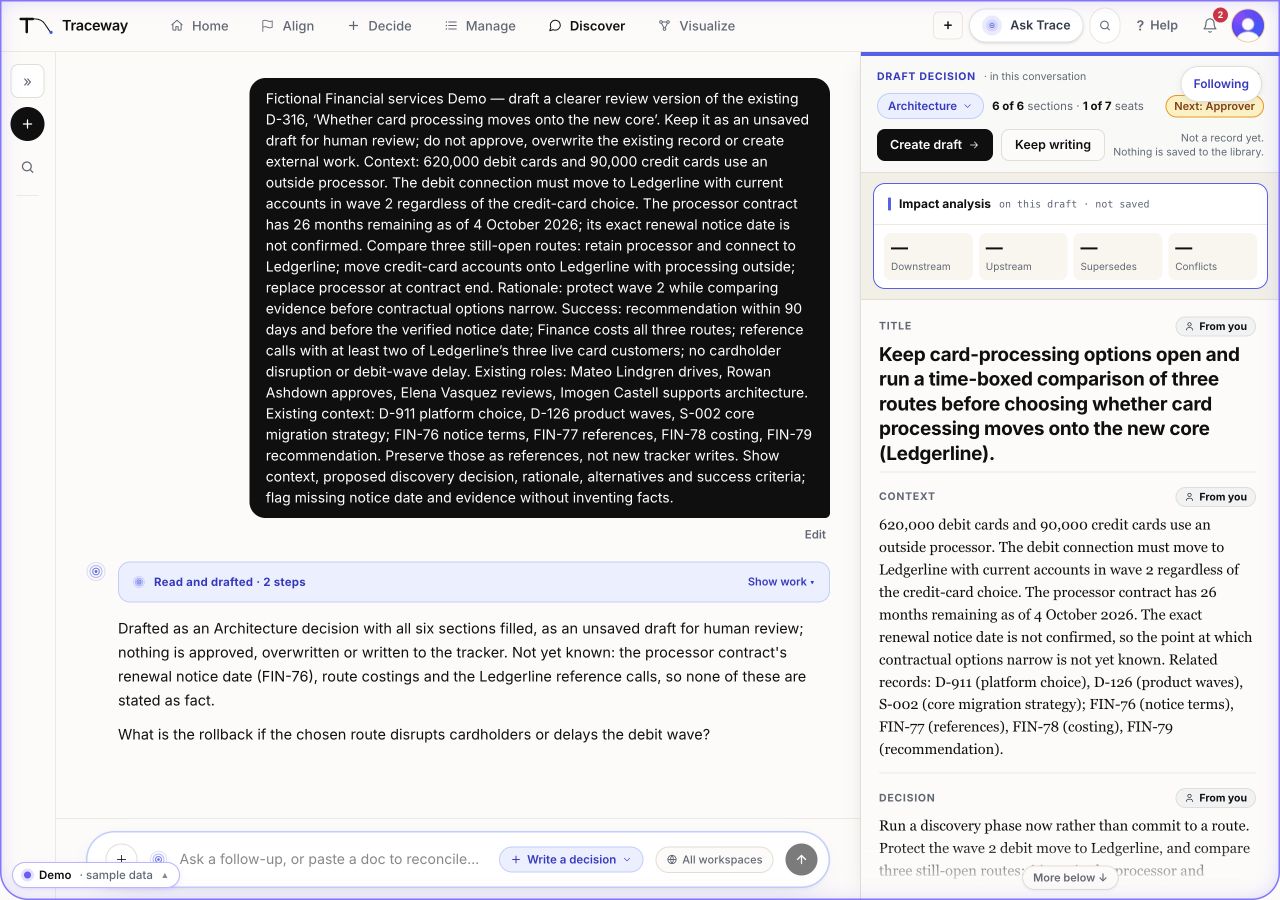
For Westmere, I would ask to see the accepted cutoff, the rejected alternative and the later agreement after the press schedule changed. Then I would follow the links to the commitments the change affects. Keeping those relationships with the decision is the reason to evaluate Traceway; the notebook's research can remain valuable input.
Bring a case with conflicting documents to a Traceway demo. Ask the reviewer to show which agreement governs the work and how they know. The next person should be able to follow it after the people in that meeting have moved on.