The business wants to reduce the cost of delivering a service. Someone proposes a slower response target outside working hours. The cost forecast improves. Before the team changes the target, it needs to recover why the faster response was agreed, who authorized it and which commitments depend on it.
This is a useful place to evaluate a decision record. I built Traceway to keep the call, rationale, alternatives and human approval connected to the strategy above it and the work below it. Its native AI helps people draft and refine the record. The people responsible still decide what trade-off the business will accept. Traceway's decision workflow
“Our strategy platform already connects goals to work”
WorkBoard describes AI that drafts OKRs and action plans, with agents that use OKRs, past meetings, actions and workstreams for context. Cascade documents relationships among objectives and initiatives, alongside AI report summaries. Atlassian Goals connects goals to projects and Jira work items; Jira Align associates objectives with work, dependencies and risks. Those relationships and context are useful material to preserve. WorkBoard AI, WorkBoard context, Cascade relationships, Cascade summaries, Atlassian Goals, Jira Align objectives
Approvals can also be part of an existing setup. Jira, for example, documents work-item approvals configured in a workflow. Check the capabilities, permissions and configuration your team actually uses. Jira approvals
I would start from the process you already have. Can you follow a specific decision from the intended outcome through its approval, into delivery, and back into review when the target changes? A configured strategy platform may already carry that record. Test it before assuming a gap.
The service target has a reason behind it
Consider Larch Systems, a fictional enterprise software business. It wants to retain premium customers by providing reliable support across time zones. Its service target is a first human response to priority incidents within thirty minutes, around the clock.
The business approved a regional staffing model to support that target. A cheaper overnight callback service was considered and rejected: customers using the software during their own working day would wait longer for help. The commercial director accepted the service promise; the operations director authorized the staffing needed to deliver it.
That decision created commitments. Operations built regional rotas. Engineering configured escalation rules. Customer teams incorporated the promise into onboarding and account reviews.
Now leadership asks for a twelve percent reduction in service delivery cost. A proposal changes the overnight response target to ninety minutes and reduces regional coverage.
The earlier rejection of a callback service deserves another look. It tells reviewers which customer consequence was previously judged unacceptable. They need to establish what has changed enough to justify accepting it now. Lower cost may be a valid reason, but someone with authority must make that call with the consequences in view.
Updating a target in the strategy system is one step. Revisiting the decision that made it an operating commitment takes more work.
Follow the commitments that used the original trade-off
Start with the intended outcome. Is Larch still trying to retain the same premium customers with the same service promise, or has leadership approved a different balance between service and cost? Keep the original target and its meaning available so later reviews can explain the change.
Then open the staffing decision. Preserve the regional model, the callback alternative and the reason it was rejected. The replacement proposal should make clear which parts change, what evidence supports the cost saving and who must authorize the new service commitment. Until that review is complete, distinguish the proposal from the decision people are currently working under.
Follow the links into delivery. The rota owner needs to review coverage. The escalation owner needs to check timing and handoffs. The customer owner needs to establish which existing promises require attention. Each may conclude that some work can continue unchanged. Record that conclusion rather than treating every related item as a change request.
This is where links become useful. They give the review somewhere concrete to start. The owners still need to confirm whether the relationships are complete and what their work actually requires.
What Traceway should help you demonstrate
In Traceway, a decision can remain connected to the goal it serves and the work that follows from it. People can use Trace's conversational drafting experience or write directly, review the proposed record and keep approval as an explicit human act. Strategy Alignment, Trace AI
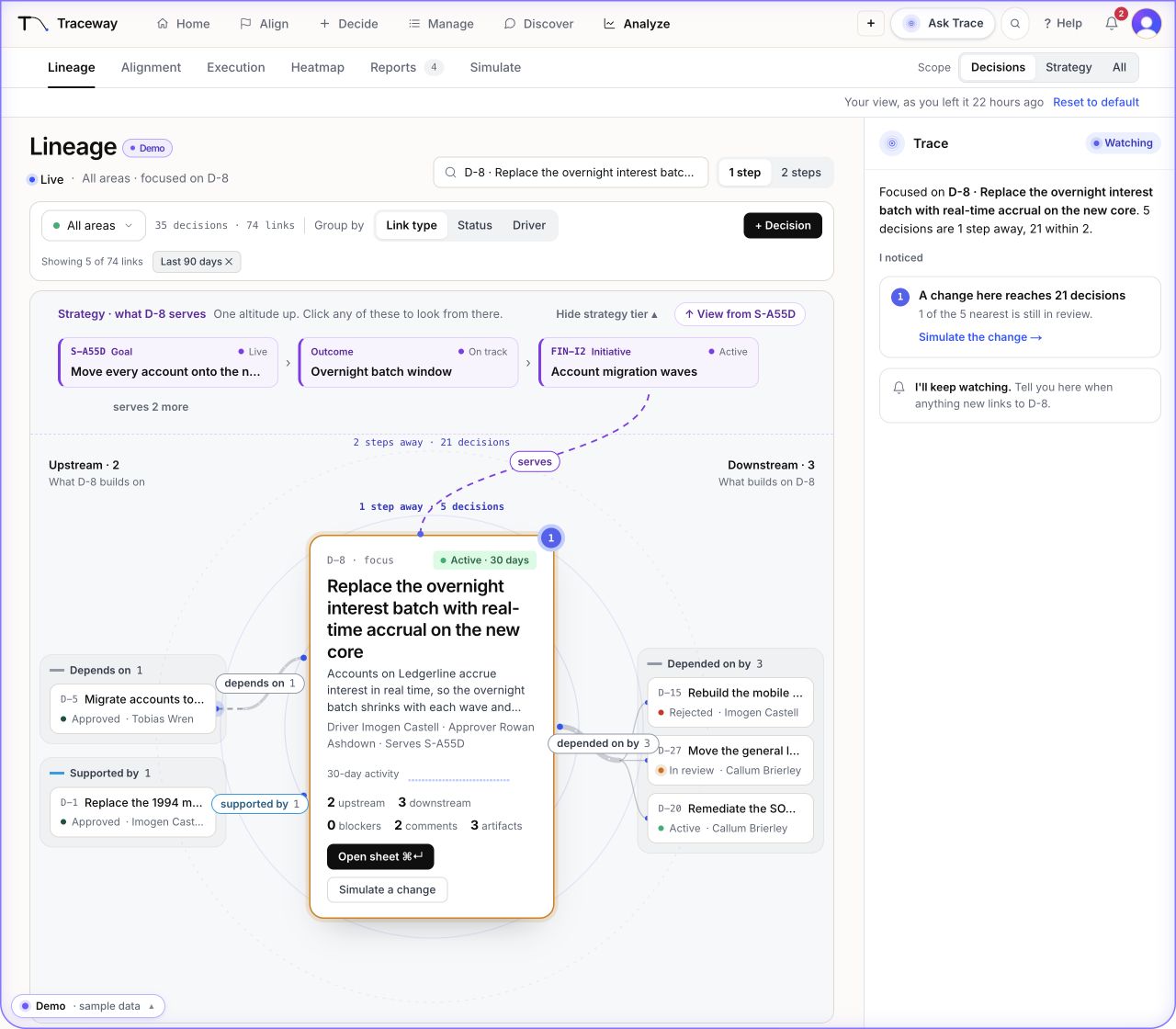
For Larch's fictional case, I would ask to see the original thirty-minute commitment, its rationale and approval, then the proposed ninety-minute replacement. I would follow that proposal into the relevant work and ask its owners to complete the review. An impact preview can inform the discussion; it does not establish that the new target was approved or that delivery work has changed.
Traceway's Jira connection creates work, then becomes read-only. Delivery owners remain responsible for subsequent tracker changes. Traceway integrations
Use one real service-target change in a Traceway demo, alongside your existing strategy process. The next review should be able to explain whether the business delivered the original promise, deliberately changed it or still has a decision to make.