Traceway and Cloverpop both describe structured decision records, approval workflows and AI assistance. If those are your requirements, both belong in the evaluation. The useful choice is how each supports the decisions your organisation actually has to make, retain and revisit.
Cloverpop's published emphasis includes configurable decision playbooks, connected-data analysis and learning from outcomes. Traceway brings native AI drafting and refinement into a shared decision record with human approval and links to strategy and delivery. Those descriptions overlap. Neither, by itself, tells you how your approval policy will work in a particular configuration.
I founded Traceway. This comparison draws on official product material, not an independent trial of both platforms. The questions below are tasks to evaluate, not results I claim to have observed.
What each product documents
Cloverpop's Decision Intelligence Platform describes playbooks for framing decisions, collaborative workflows that route approvals, and a Decision Bank retaining rationale, data sources and outcomes. Its official platform explanation, published March 2025, also describes Decision Flows, auditing and configurable governance. This is substantial overlap with the need for a maintained business decision record.
Its D-Sight page puts analysis and recommendations at the centre: connected data, mapped decision logic and recommendations leaders can accept, adjust or override. If your process depends on recurring analysis, establish which inputs, models and configuration are included in the proposed implementation. An advertised platform capability does not settle that scope.
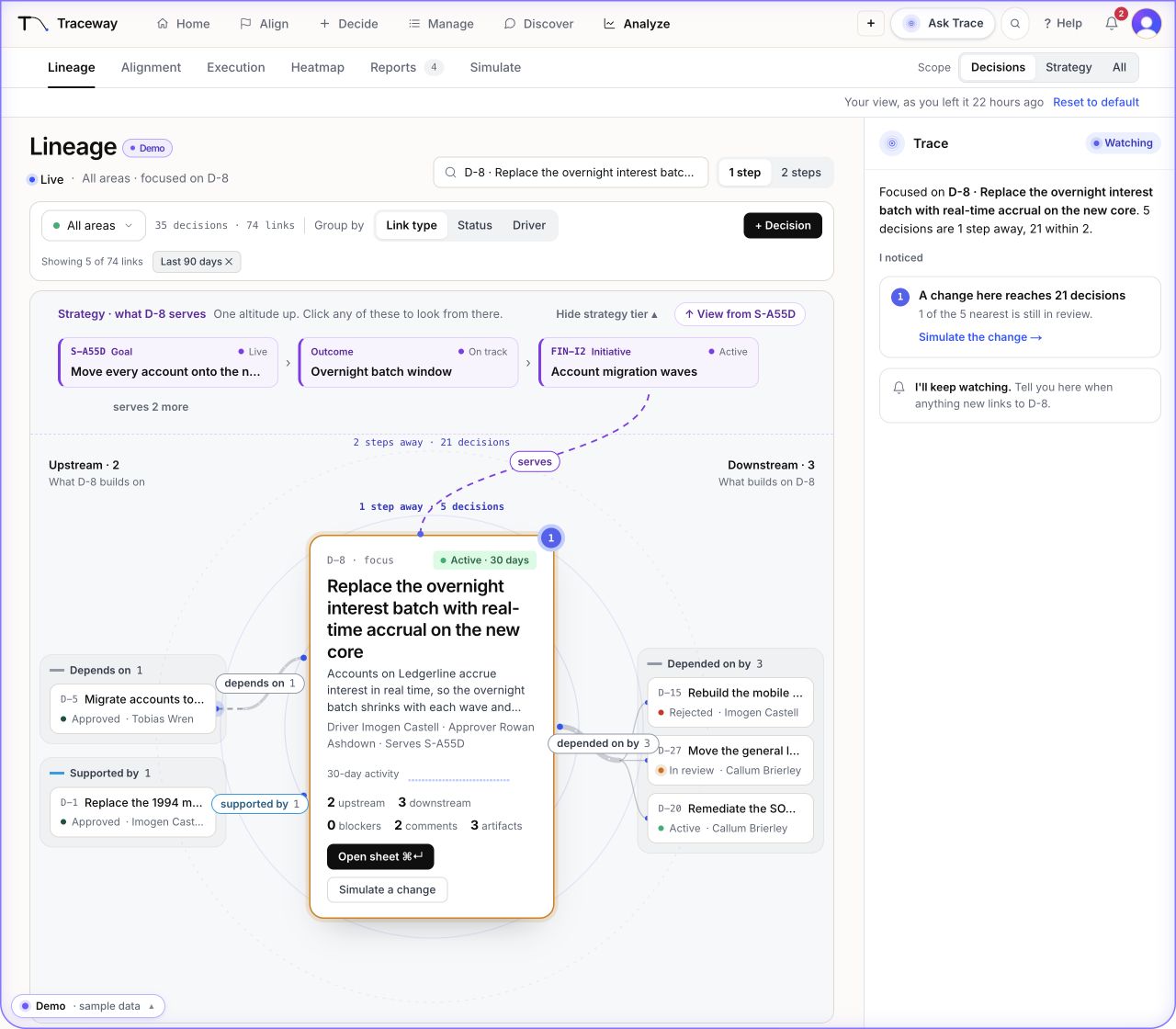
Traceway's Decision Intelligence describes the record's rationale, alternatives, roles and approval. Trace AI provides a conversational way to draft and refine it, while people can also write directly. Approval remains a separate human act. Our Strategy Alignment material connects decisions to the goals they serve and the work that follows.
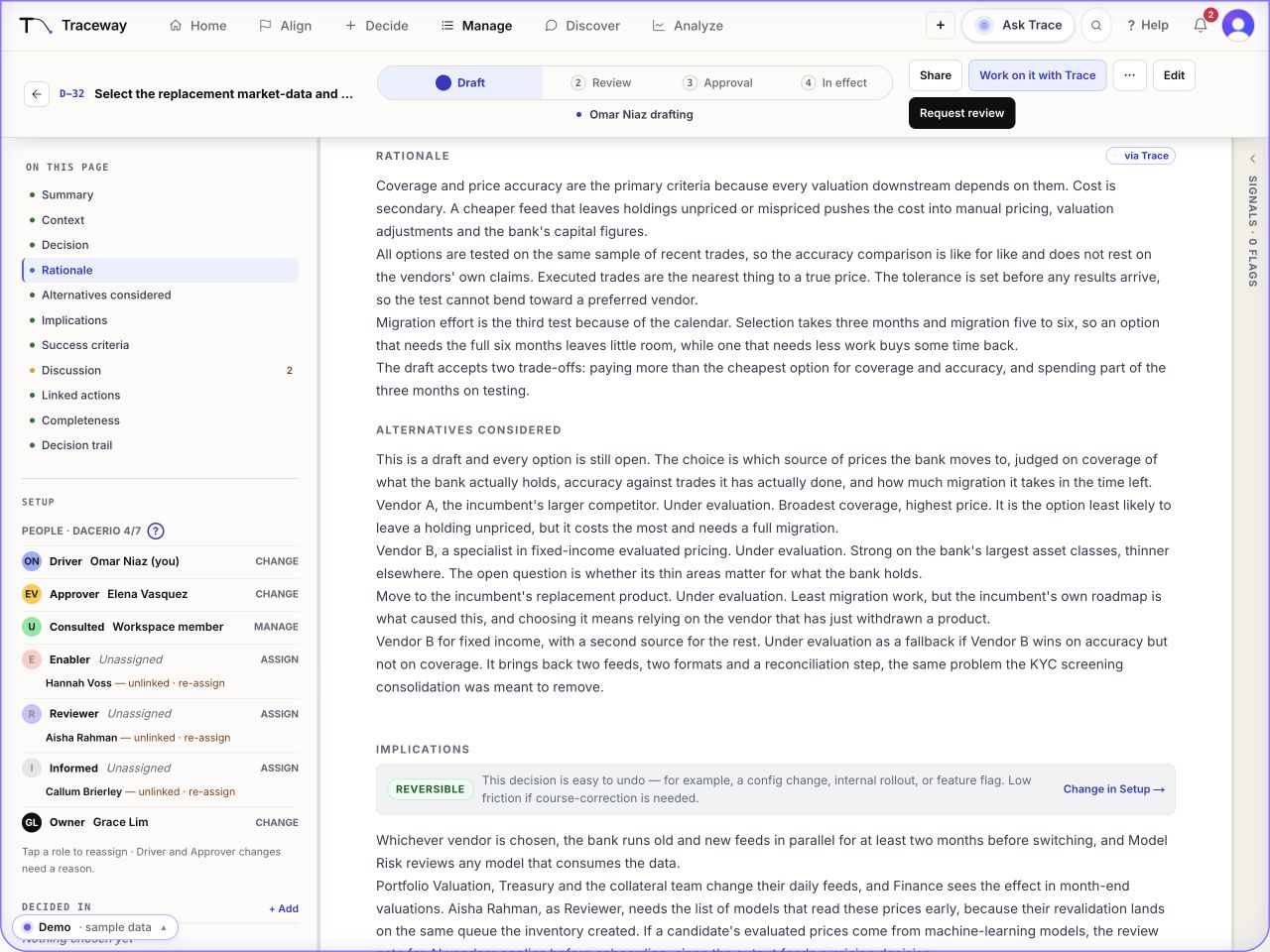
That is the workflow I want buyers to inspect: work through the question, review the proposed record, approve it with the right authority, and keep the reasoning connected to delivery. Agree the required product scope and configuration before treating any part of that as a procurement commitment.
| Part of the decision | Cloverpop's published approach | Traceway's published approach |
|---|---|---|
| Structure | Playbooks and Decision Flows organise the process and its governance. | Decision Intelligence brings the call, alternatives and approval into the record. |
| AI contribution | D-Sight analyses inputs and produces recommendations. | Trace AI helps draft and refine; human approval stays explicit. |
| Continuing context | The Decision Bank retains rationale, sources and outcomes. | Strategy Alignment connects the decision to goals and delivery work. |
These are documented capabilities reviewed on the date above, not feature scores. Their availability and configuration need to be confirmed in the scope you would buy. The table does not establish that either product lacks the other's approach.
Put the approval boundary under pressure
Use a fictional decision: postpone retirement of a legacy employee self-service portal for 90 days because accessibility testing of its replacement is incomplete. The HR operations director owns the call. Accessibility, security and delivery leads contribute. The alternatives are to retire on schedule with assisted support, run both portals temporarily, or delay the migration.
First, have the participants develop the proposal in each product. Keep the unfinished testing explicit. If AI suggests a recommendation, inspect its basis: has it preserved the uncertainty, or written as though testing passed? Can the approver see why the preferred option was chosen and why the others were set aside?
Then approve the delay and change the proposal to include another employee group. That is a different commitment. Inspect how the product presents the earlier approval, the revised scope and anything awaiting further approval. Establish which rules the configured workflow enforces and which depend on someone following the process. This matters in both platforms.
Follow the decision into the work
The portal decision leaves several jobs: finish testing, keep an assisted route available and revise the migration plan. Have the delivery lead identify which work follows from the decision and the business reason for the delay. Then introduce a missed testing milestone. The team must decide whether the 90-day extension is still enough.
In Traceway, inspect that path through the decision's strategy and delivery links. Our current Jira connection creates work, then becomes read-only. A revised decision is not evidence that Jira tasks have automatically changed; the delivery owner must account for the required tracker updates.
For Cloverpop, examine how the configured flow, Decision Bank record and outcome review support this same handoff. Establish how resulting work is represented in your proposed setup. An integration or history detail absent from the pages cited here remains unverified; it is not proof that the capability is unavailable.
Make the purchase around the record you need
I would judge the fit at the point where the HR director and delivery lead can explain the same commitment: what was approved, the uncertainty accepted, the work it authorised and what now needs another decision. Keep any manual handoffs visible in that assessment.
If this is the kind of record you need, bring the portal scenario or your own decision to a Traceway demo. Ask us to show the native AI workflow, human approval and links to strategy and delivery in the scope you are considering.