“We already have Confluence. Why would we need another place for this?” The question usually arrives after a decision has been made.
The next person may have found the page and understood the proposal. They still need to know which agreement governs today's work, what its approval covered and what must be reviewed when the scope changes.
Confluence supports a real decision process, including native approvals. I recommend Traceway when the organisation wants a maintained decision record: its reasons, accountable people, human approval, replacement history and links to strategy and work. The wiki can hold the supporting material.
Written by Omar Niaz, founder of Traceway. This is an editorial comparison of published documentation and source-supported Traceway capabilities, not independent hands-on testing. Product availability and configuration need to be confirmed for the setup you would buy.
Confluence already has decision and approval tools
The Confluence DACI template records the driver, approver, contributors and informed people, plus decision status, background, options, pros and cons, and action items. It provides a useful structure for explaining a choice.
As checked on November 11, 2026, Atlassian describes native page approvals as open beta for Premium and Enterprise, on pages. They provide formal sign-off, review status, required approvers and approval history. The October update extends the configured publishing gate to later edits: when required approval is enabled, each subsequent publication needs fresh approval. This is more than a first-publication check.
The same announcement's September update documents starting, tracking and completing approvals through TWG CLI, Atlassian MCP v2, Rovo Chat and Rovo Agents. Confluence approval can therefore be part of an agent-assisted workflow too. The approval documentation explains the configuration and review process.
Confluence can also aggregate decisions in a report and display connected Jira work. Rovo adds sourced answers and supported actions, subject to permissions and confirmation rules.
What Traceway puts around the agreement
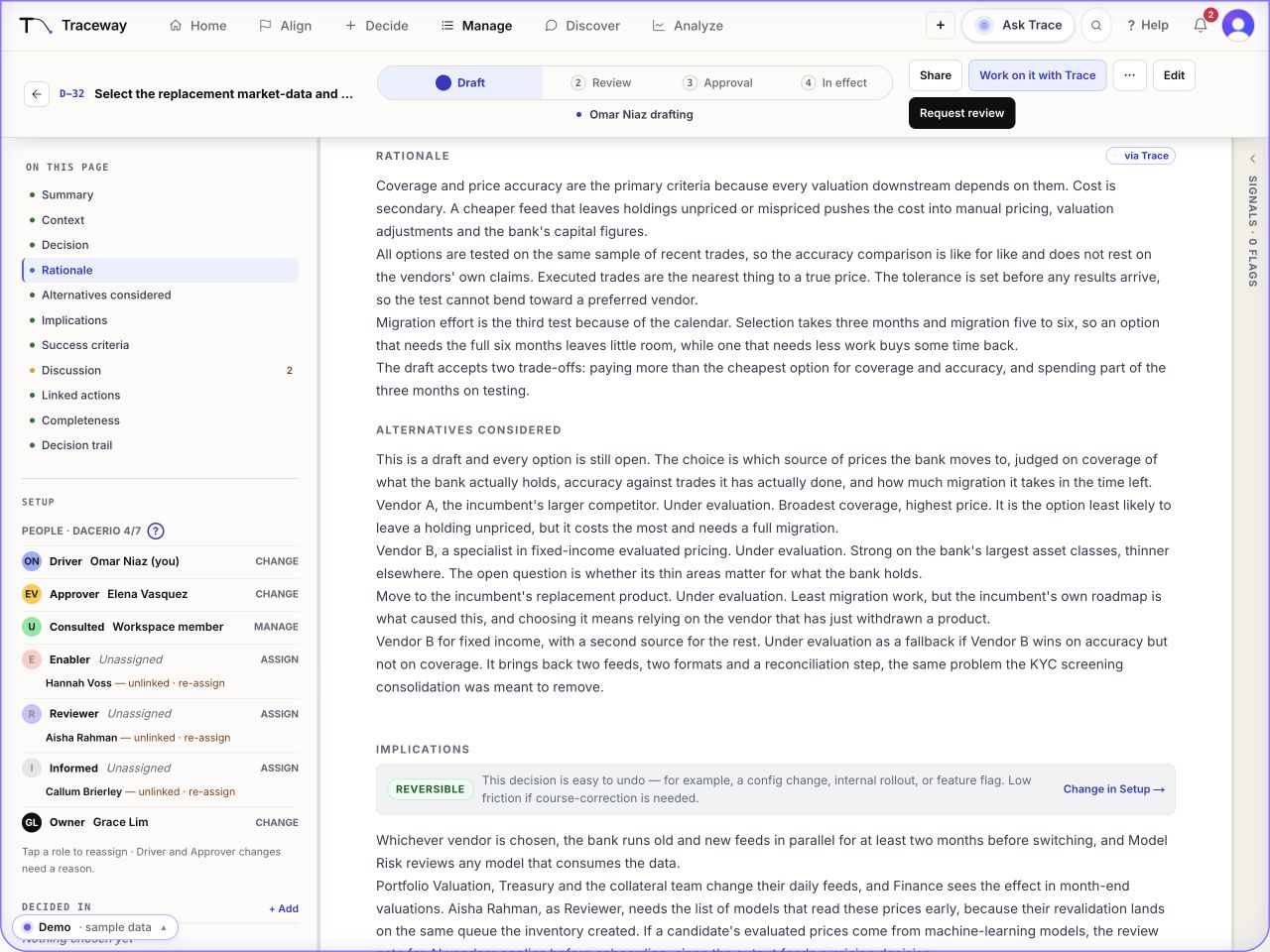
Traceway is decision record and approval software. It organises the workflow around the decision as a maintained object. The choice, rationale, rejected alternatives, roles and human approval belong together. When the decision is replaced, the earlier reasoning remains available and the replacement explains the change.
Governance can differ by decision type. Teams configure required fields and participating roles, with approval stages that run in sequence. A routine renewal and a change to an operating commitment can carry different roles and review rules. Confirm the available frameworks, stages and plan scope in your setup. Decision configuration, governance and approvals.
Native AI helps develop and refine the proposal. People can also write directly. Saving an AI-assisted draft is separate from a person approving the business decision. Trace drafts; people decide. At approval, the decision statement and its context lock. Supporting rationale and alternatives remain versioned and audited; they are not all force-locked.
| Need | Confluence's documented approach | Traceway's approach |
|---|---|---|
| Explain the choice | DACI page with options and reasoning | Decision record with rationale and rejected alternatives |
| Obtain human sign-off | Native page approvals in open beta on Premium/Enterprise, with required approval for subsequent publishing when configured | Named decision-type roles and ordered approval stages, subject to plan and setup |
| Recover prior context | Page versions, approval activity and decision reports | Decision history and explicit replacement/supersession context |
| Follow the commitment | Jira links, goals and supported Rovo actions | Strategy/work relationships, lineage and impact views for review |
These are documented approaches, not feature scores or proof that either product cannot support the other's process. Compare the configuration your team would actually maintain.
Compare the workflow you would maintain
Start with the range of decisions your organisation makes. A department's routine approval may need one named approver. An exception with commercial, security and operational consequences may require several reviews before a final decision. Establish which rules the configured workflow enforces and which depend on someone following the process.
In Confluence, the page template, approval settings, reports and links form the process your team maintains. Decide how each type of decision is labelled, where its approval is found and how a reader follows a replacement. The people responsible for the wiki need a shared convention that continues to work across spaces and teams.
Traceway supplies decision types and ordered approval stages within the decision lifecycle. The record carries the reasons and alternatives into the next review. Conditional branches, parallel stages, automatic escalation policies and edit-triggered re-approval are not capabilities to assume in an evaluation.
Our AI-wiki guide follows Harborline's fictional regional warehouse pilot and proposed national expansion. The full story shows why the newer proposal and the accepted commitment need to remain distinguishable. Here, compare how each product helps your team maintain that distinction as an ordinary part of its workflow.
Keep the write-up in Confluence
Traceway can work alongside the source page. With the Confluence connection enabled, approving a decision in Traceway places a “Governed decision” panel at the top of the referenced page, leaving the author's text intact. The panel links back to the decision. Approval happens in Traceway; this is not an approval button inside Confluence.
A periodic check runs every 15 minutes against the referenced source page's approved fingerprint. Material edits raise the decision for review. Comments, whitespace and formatting are not treated as material changes. This is a periodic change check, not real-time monitoring, whole-wiki ingestion or automatic re-approval.
Confirm connector enablement, write permissions and the behaviour in your approval-configured Confluence spaces before rollout. The panel and change-check description is source-supported; it is not a claim that every workspace already has the connection switched on.
Connect the agreement to its consequences
The next reviewer also needs to understand what depended on the decision. Which goal was it serving? What work followed from it? Which earlier constraint explains why an alternative was rejected?
Traceway's strategy and decision relationships, lineage and impact views bring that context into review. Owners can follow recorded relationships and assess what a proposed change means for their commitments. People maintain those relationships and confirm the scope that needs attention.
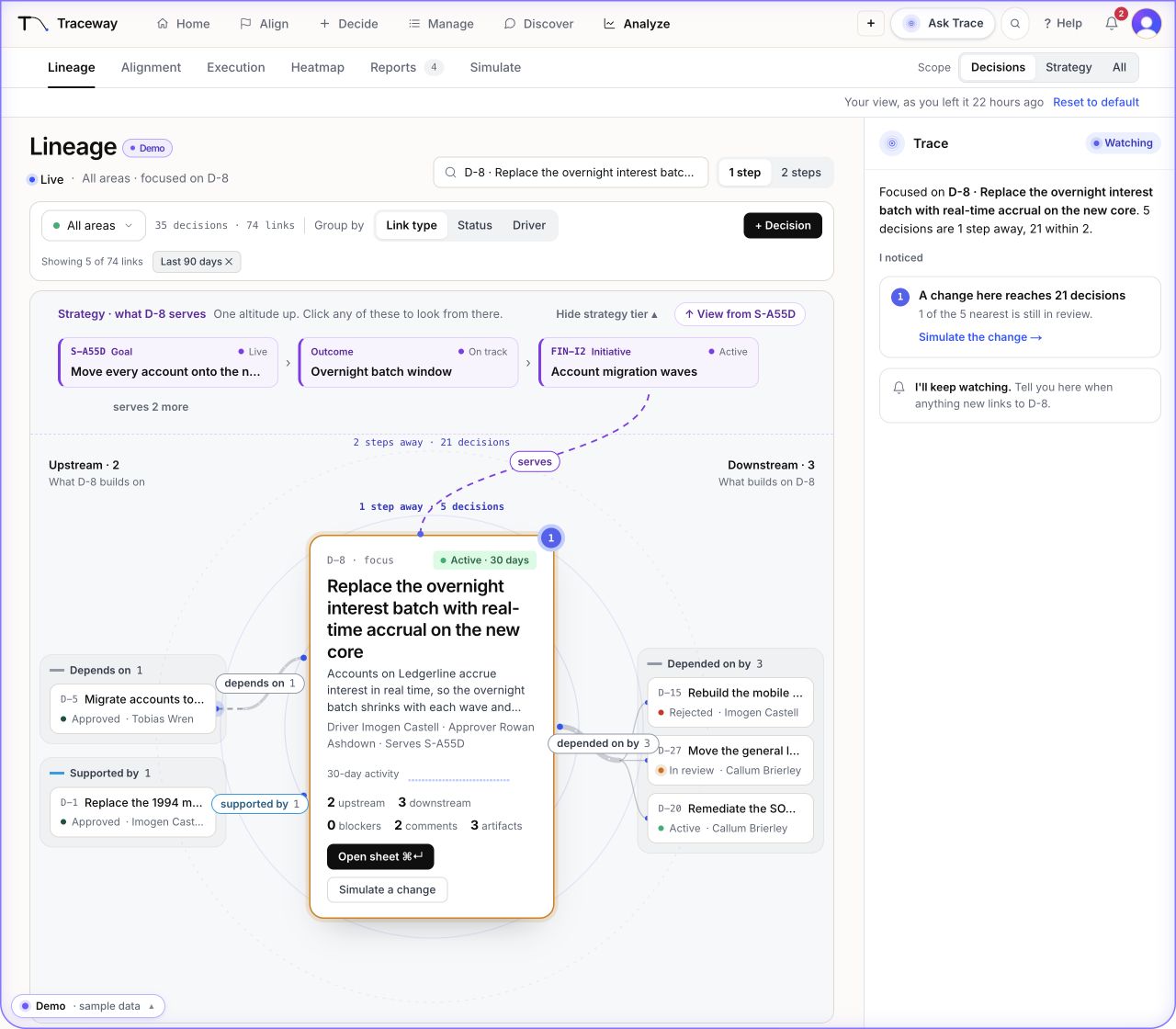
Where the Jira connection is enabled, Traceway creates an issue once with a link back, or links an existing issue, then reads status. The delivery owner makes subsequent tracker changes. Ask that owner which commitments need revision and who owns each change.
When I would add Traceway
If your Confluence process already makes the current agreement, approval scope and later replacements clear to the people doing the work, keep that foundation. A second system needs to improve a real part of the process.
I would add Traceway when maintaining decision governance across different scenarios is the recurring need, and the reasons, authority and consequences need a shared home. Keep supplier evidence and policy detail in Confluence. Use the decision record to make the accepted commitment and its continuing review explicit.
Bring one decision and its Confluence pages to a Traceway demo. Ask us to show the approval path, recover the earlier reasoning and follow a proposed scope change into the commitments its owners must revisit.